What a TAF Actually Tells You — and What It Doesn’t
TAF reading has become harder to navigate with all the jargon flying around. As someone who spent too many evenings hunched over weather charts during ground school, I worked through the fundamentals of terminal forecasts the hard way. Today, I will share it all with you.
But what is a TAF? In essence, it’s a Terminal Aerodrome Forecast — a weather prediction for a specific airport covering the next 24 to 30 hours. But it’s much more than that. It’s also, critically, not a guarantee. Forecasters are human. Meteorological data has gaps. The educated guess baked into every TAF can be wrong, and sometimes it is.
Here’s the thing that trips up almost every student pilot I’ve talked to: the TAF covers a 5-statute-mile radius around the airport. That’s it. Not your route. Not the field 15 miles east. Just that one spot on the ground. You’ll read a gorgeous TAF — “VFR all day, visibility unlimited” — then hit actual IMC conditions 10 miles out that nobody forecast. The TAF never lied. It just wasn’t talking about where you were.
Here’s a real example we’ll use throughout this article. This is from Shenandoah Valley Regional Airport (KHOT) in Weyers Cave, Virginia:
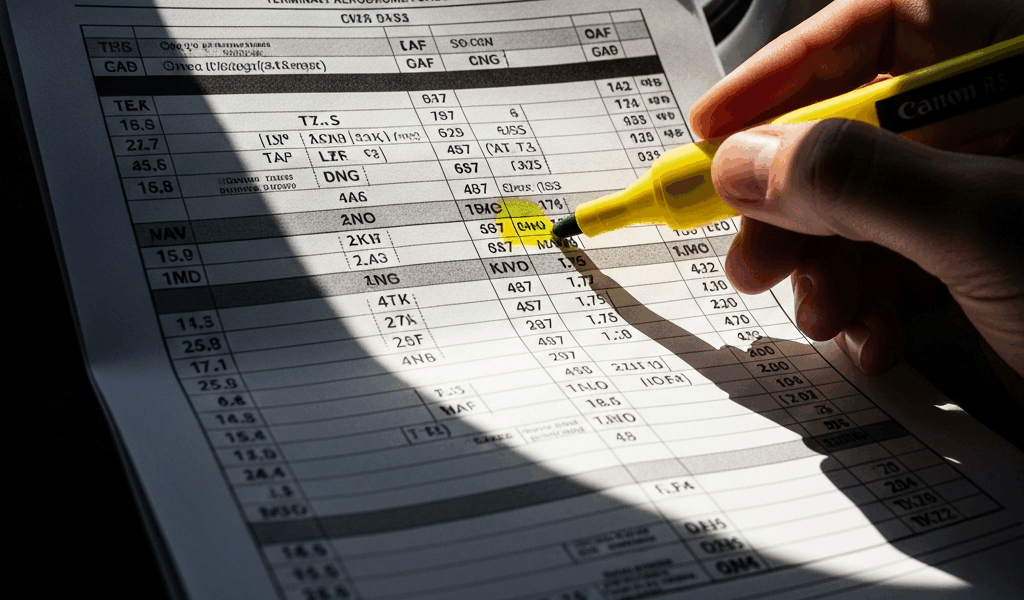
KHOT 121720Z 121818 31012G20 10SM FEW250 TEMPO 1818/1920 4SM -RA OVC040 FM200000 32008 10SM SCT250
Don’t panic. We’re going to walk through every piece of this together.
Breaking Down the TAF Line by Line
Start at the beginning. The format matters because the order never changes.
The Header: KHOT 121720Z
KHOT is the four-letter ICAO identifier for the airport. Easy. The 121720Z part is where students slow down. The 12 is the date — the 12th of the month. The 1720Z is Zulu time, also called UTC or GMT. That translates to 1:20 p.m. Eastern Standard Time, or 12:20 p.m. if daylight saving is in effect.
Zulu conversion kills every student pilot I’ve ever known. You have to do the math every single time. Flying on October 13th at 2 p.m. local while reading a TAF issued October 12th at 1720Z? You’re already 19 hours into that forecast. That matters — a lot.
Valid Period: 121818
This TAF is valid from October 12th at 1800Z through October 13th at 1800Z. Twenty-four hours. Some TAFs stretch to 30 hours, but honestly, you’ll rarely touch those as a student. The main question is simple: does your planned flight window sit inside this range? If not, find a newer TAF.
The Base Forecast: 31012G20 10SM FEW250
Wind 310 degrees at 12 knots, gusting to 20. Visibility 10 statute miles. Few clouds at 25,000 feet. Translation: it’s a genuinely nice day. Winds out of the northwest, some light turbulence possible near the gusts. The ceiling is so high you’ll probably never even register those clouds. Go fly.
The TEMPO Group: TEMPO 1818/1920 4SM -RA OVC040
Temporarily — between 1800Z and 2000Z on October 13th, roughly 2 p.m. to 4 p.m. Eastern — visibility drops to 4 statute miles with light rain. Overcast ceiling moves in at 4,000 feet. That sounds alarming until you understand what TEMPO actually means. We’re talking 30 to 45 minutes of actual degraded weather scattered across that two-hour window. Not the whole window. Not a wall of weather. Intermittent dips.
The FM Group: FM200000 32008 10SM SCT250
FM means “from.” At 0000Z on October 14th — 8 p.m. Eastern on the 13th — everything changes permanently. Wind shifts to 320 degrees at 8 knots. Visibility jumps back to 10 statute miles. Scattered clouds at 25,000 feet. The TEMPO drama is over. New regime, cleaner skies, steady conditions for the rest of the valid period.
FM vs. TEMPO vs. BECMG — Why Students Mix These Up
The piece that matters most here. Most ground school weather training glosses right over these distinctions, but this is where the real go/no-go decisions actually live.
TEMPO is temporary. Conditions dip, then climb back out. The degradation lasts less than an hour even when the forecast window is two hours wide. If your timing is lucky, you might not hit it at all. Old-school instructors call it “temporary fluctuations.” Weather shows up, then leaves.
FM is a firm, permanent change. From that timestamp forward, you’re in a new weather regime until the next FM group appears — or the TAF expires. I’ve watched students misread an FM group showing 40-knot wind shear as something temporary, something they’d fly through and out the other side of. That’s wrong, and it’s dangerous. When FM appears, the change doesn’t go away.
BECMG means becoming. Gradual change over a defined window, usually 30 minutes to two hours. At 1200Z, visibility is 8 miles. By 1400Z, it’s down to 5 miles. The change is linear, real-time, not bursty. Students who encounter BECMG for the first time treat it like TEMPO — they assume the weather will bounce back. It won’t. BECMG moves in one direction and stays there.
That’s what makes this distinction endearing to us student pilots — once it clicks, everything else in the TAF makes sense. So, without further ado, let’s talk about actually using the thing.
Go or No-Go — How to Use the TAF as a Student Pilot
You’re sitting at your instructor’s desk the evening before your solo. You pull up the TAF. You read it. Now what?
First, you should know your legal minimums cold — at least if you’re flying VFR. In controlled airspace: 3 statute miles visibility, 1,000-foot ceiling. Outside controlled airspace: 1 statute mile, clear of clouds. Those numbers don’t flex. Check every group in the TAF against them for your entire flight window.
Back to our KHOT example. The base forecast gives you 10 miles and a 25,000-foot ceiling. Legal, comfortable, no issues. The TEMPO dips to 4 miles and 4,000 feet — still legal in controlled airspace, still above minimums. The FM group restores 10 miles visibility with scattered high clouds. Clean flight, top to bottom.
But — and I mean this — if any part of that TAF doesn’t make complete sense to you, don’t go. Call your CFI. Text them a screenshot of the raw TAF and ask them to walk you through it. A TAF you half-understood is genuinely worse than no TAF at all, because you’ll depart anyway and feel like you did your homework. Don’t do what I did.
Common TAF Misreads That Catch Students Off Guard
- Thunderstorm groups (TS). TS in a TAF is not a suggestion and it’s not a footnote. That’s embedded convection — possibly severe. In a TEMPO group, it might miss you depending on timing. In the base forecast or an FM group, you do not go. Full stop. I’m apparently the kind of person who once thought “I can handle a little thunderstorm in a Cessna 172.” That thinking does not end well. Small plane, solo, thunderstorm: no.
- Wind shear (WS). Appears as a line like WS020/18045KT — wind shear at 2,000 feet with winds at 180 degrees, 45 knots. Students see this buried in the TAF and treat it like background noise. It’s not. Shear that strong will end a flight in ways you don’t recover from. Avoid it entirely.
- NSW versus blank space. NSW stands for “no significant weather,” which explicitly means the weather is boring and fine. If the weather field is just empty — nothing there — the forecast may be incomplete or the transmission dropped data. Don’t assume NSW. Call Flight Service at 1-800-WX-BRIEF and confirm.
- Forgetting the TAF is just for that one airport. Flying from your home field to KHOT? The KHOT TAF covers your destination. You still need the TAF for your departure airport. You still need PIREPs from pilots already flying the route. One TAF is never the whole picture.
- Misreading the valid period. TAF issued at 1720Z on the 12th, valid until 1800Z on the 13th — if you’re flying at 1600Z on the 13th, you’re technically within the window, but barely. Weather forecasts decay in accuracy the further out you push them. If you’re flying in the last two hours of a TAF’s validity, pull a fresh one before you brief.
After the TAF, pull the current METAR for the same airport. That’s real, observed weather happening right now. If the METAR shows 2 miles visibility and the TAF says 10, something broke down somewhere — either the forecast missed badly or conditions are changing faster than expected. Cross-check with PIREPs from pilots who are actually up there. The TAF is one piece of a bigger puzzle. Treat it that way.
Your solo is coming. The TAF won’t ruin it. But reading it wrong will. Take the extra five minutes. Your instructor will notice — and more importantly, you’ll know you made the right call before you ever left the ground.



Stay in the loop
Get the latest skyhighflighttraining updates delivered to your inbox.