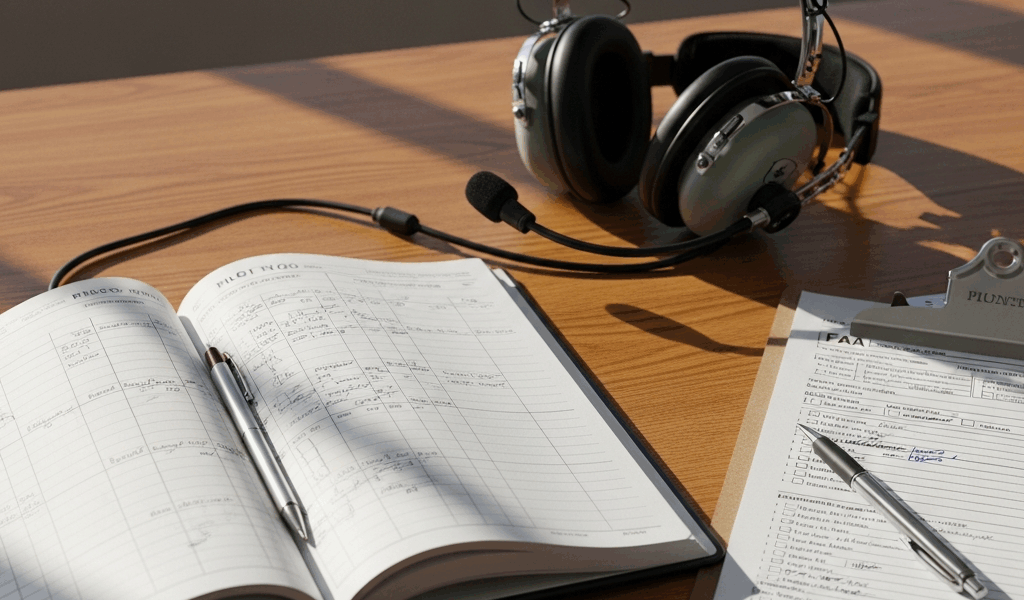
What Happens at the Moment You Fail
Failed checkride prep has started getting harder to follow with all the conflicting advice flying around. So let me just tell you what actually happens — the real sequence, not the forum speculation.
The DPE says the words. Your stomach drops. Hands go numb. You’re already replaying that last maneuver, knowing exactly where it unraveled.
Here’s the thing most students miss completely: the examiner isn’t done with you yet.
They’ll issue a Notice of Disapproval — FAA Form 8710-1, with an addendum listing every specific task you didn’t demonstrate to practical test standards. Not a wipeout notice. A surgical list. You keep credit for everything that went well. Your oral, your preflight walk-around, your navigation work — all of it stays passed. Only the failed tasks go back on the table.
Frustrated by the emotional fog that follows a disapproval, most students completely miss the good news buried inside that form. A partial pass is genuinely real. The FAA structured the checkride in discrete, testable segments precisely so nobody starts from zero after one bad maneuver.
The DPE walks you through the paperwork right there — sometimes in the aircraft, sometimes at the school. They show you exactly which tasks are marked “not passed.” Some examiners are decent about it. A few will say something like “You clearly know your material — this just needs another shot.” Others hand you the form and disappear. Either way, you’re holding a document that feels like total failure but legally means something much narrower: you retest only what didn’t meet standards.
That distinction matters more than people realize — both practically and mentally. Worth putting near the top, because the emotional hit of failing tends to bury the fact that you’re not starting from scratch.
The Paperwork You Need to Understand
The Notice of Disapproval is your roadmap. It’s also time-sensitive — and that part catches people off guard.
You have sixty days from the issue date to schedule and complete your retest. Sounds like plenty of time. Then you’re three weeks out, there’s no DPE availability in your region, and suddenly sixty days feels very short.
Here’s how the sequence actually runs:
- DPE gives you the original Notice of Disapproval — your copy to keep
- A copy goes to the FSDO covering your jurisdiction
- Your CFI gets the specifics on what failed
- You and your CFI schedule focused training on those exact areas
- When you’re ready, your CFI initiates the retest request — with the same DPE or a different one
The 60-day window is real. Miss it and you start completely over — new oral, new flight, all of it, from the very beginning. I’ve never personally watched a student hit that deadline, but I’ve seen it get uncomfortably close because DPE scheduling dragged out longer than anyone expected. Call early. Some examiners book three weeks out during summer, easy.
Run everything through your CFI. Don’t call the DPE yourself trying to arrange a makeup — that’s not how the procedure works. Your CFI handles the FSDO notification, confirms you’ve completed adequate additional training, and gets you into the DPE’s calendar. Your job is showing up prepared.
On the retest paperwork itself, the DPE notes it as an airman practical test retest — not a brand-new checkride. That classification shows up on your temporary airman certificate. There’s no visible asterisk on the certificate once you hold it. But knowing it’s logged as a retest rather than a fresh failure does something useful for your head.
Most Common Reasons Students Fail — and Then Fail Again
The pattern I see most often: same task area, lit up twice. Student fails slow flight on attempt one, does two weeks of slow-flight drills, and somehow fails slow flight again on attempt two. Different examiner. Different airplane. Same problem.
That happens because the training targeted the symptom instead of the actual root cause.
Slow flight failures almost always trace back to one of three things: poor trim discipline, inability to cross-check instruments while hand-flying, or genuine panic when the aircraft gets slow and mushy. A CFI will often pile on more slow-flight repetitions without ever diagnosing which of those three broke the student. So the student logs another ten slow flights, none of them targeting the real weakness. Checkride two arrives — and slow flight is still a mess.
Same logic applies to crosswind landings, systems knowledge on the oral, emergency procedure flows. Whatever failed the first time is a red flag that needs root-cause analysis, not just more volume.
I once failed a checkride on steep turns and unusual attitude recovery. Thought I needed more steep turns. What I actually needed was to recognize that I was overcontrolling the roll input and then freezing when the nose pitched. Flew twenty more steep turns before a different CFI finally spotted it. Skip past the mistake I made — ask the DPE for specifics during the debrief instead of assuming you already understand what went wrong.
Knowledge gaps work the same way. Student misses several systems questions, goes back and rereads the POH twice, misses systems questions again on the retest. Same gaps. The problem was never exposure to the material — it was a fundamental confusion about how those systems actually behave operationally. That requires a different kind of study than another pass through the handbook.
How to Prepare Differently for the Retest
Retest prep is not a repeat of original checkride prep. You’re not drilling the whole curriculum again — you’re precision-targeting the specific areas that didn’t hold up.
Start with a debrief conversation with your CFI. Ask for real specifics. Not “I failed slow flight” but “I failed slow flight because my pitch control was hunting and I wasn’t cross-checking the altimeter.” Write it down. That sentence is your training plan.
Then isolate that skill across multiple environments. Slow flight in calm air, slow flight in light chop, slow flight with different power configurations. If the failure was knowledge-based, work on conceptual understanding — not memorization. Why does that system work the way it does? When would you actually need to understand it while flying?
Chair flying or simulator work is brutally efficient here. One hour in a sim doing nothing but the failed task — with your CFI coaching in real time — will often surface more problems than three hours of actual flying. You can repeat the exact condition instantly. That matters.
Then schedule at least one full-length practice flight where your CFI runs the whole thing using the Airman Certification Standards as if they’re the DPE. You need to see what passing actually looks like from the evaluator’s side — not just what you think it looks like from the left seat.
If anxiety was a factor during the original checkride — and for a lot of students it genuinely is — address it directly. Some pilots fly beautifully in training and completely freeze when the DPE sits down. That’s a separate problem that needs a separate fix. Shorter check flights with unfamiliar evaluators can help. So can a frank conversation about what specifically triggered the freeze — perfectionism, fear of judgment, replaying a previous bad experience. Sometimes that conversation matters more than another hour of maneuver practice.
Scheduling the Retest and What to Expect
Your CFI handles finding the DPE for the retest. You can request the same examiner or a different one — both options are completely valid. Some students want to prove something to the original DPE. Others want a clean slate. Honestly, there’s no strategic advantage either way.
Bring the same documents you brought to the first checkride: logbook, medical certificate, government-issued ID, written test results, and your Notice of Disapproval. The DPE will also want a short summary of the training you completed between attempts — your CFI can write that up.
The retest format runs differently than the original. The examiner focuses almost entirely on the failed areas. You probably won’t fly a full cross-country or run through every required maneuver. You’ll demonstrate the specific tasks that didn’t meet standards, plus a handful of representative tasks to confirm you haven’t regressed elsewhere. Not a shorter checkride — a focused one. That’s an important distinction.
Expect professional, straightforward behavior from the examiner. DPEs are not adversarial. They want competent pilots in the system. An examiner who failed you once isn’t rooting for you to fail again — they’re looking for evidence that the problem got fixed. Showing up calm, prepared, and honest about exactly what you practiced changes the entire dynamic in the room.
Thousands of pilots have walked this exact path and come out the other side with their certificate. You’ve got this.




Stay in the loop
Get the latest skyhighflighttraining updates delivered to your inbox.