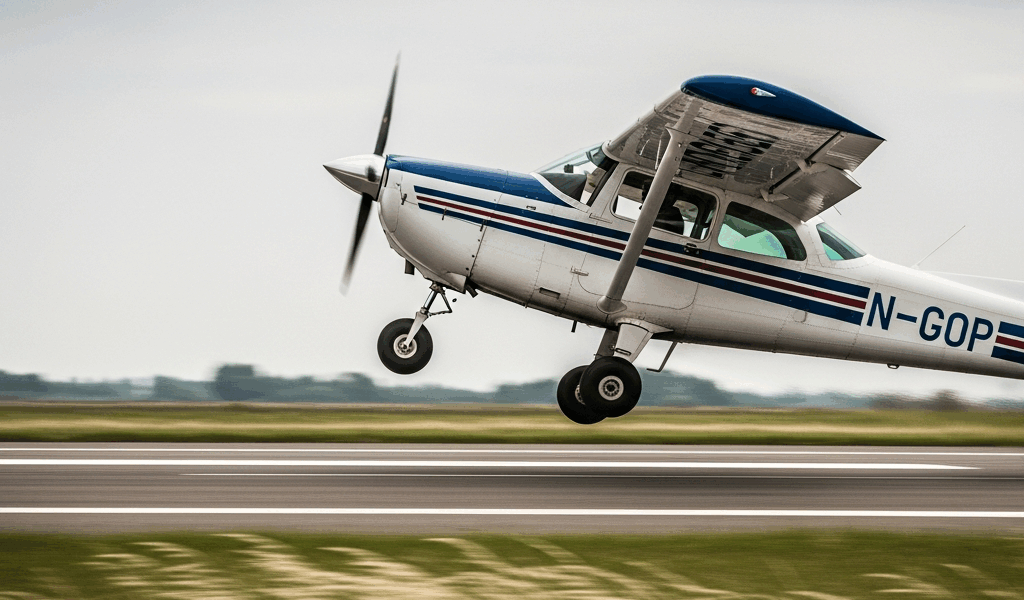
The Technique That Contradicts Everything You Just Learned
Soft field takeoffs have gotten messy with all the conflicting advice flying around. And honestly, that’s because the technique genuinely feels wrong — at least if you’ve spent the last month drilling on concrete. You held the nose on centerline. You waited for airspeed. You rotated at Vr and climbed out clean. Textbook stuff. Then your instructor drives you out to a grass strip, and suddenly none of that applies.
You’re supposed to haul back on the yoke the moment you start rolling. Not gently. Real pressure. The kind that makes your gut say “stop, you’re pitching up way too much.” Then — and this is the part that breaks most students — you’re supposed to ease that pressure off while you’re still accelerating on the ground. Almost push forward. It inverts every habit you’ve built, and your muscle memory absolutely knows it.
Quick callout up front. Understanding the actual goal behind each input changes everything. So, without further ado, let’s dive in.
What You Are Actually Trying to Do on a Soft Surface
But what is a soft field takeoff, really? In essence, it’s a technique for getting airborne on surfaces that want to stop you. But it’s much more than that. The real enemy on grass, dirt, or snow isn’t a lack of power. It’s the nosewheel. That little wheel can dig into soft earth — maybe 3 or 4 inches on a soggy April morning — and stop you cold before you’ve hit 30 knots. The main gear settles. The nose follows. If the nosegear catches hard enough, you stop. Or worse.
Your job breaks down into two things. Unload the nosewheel as fast as possible. Then accelerate in ground effect — that invisible cushion of compressed air between your wing and the earth — until you have enough speed to actually climb.
That’s it. Two goals. Everything else in the maneuver serves one of them. Most ground instruction glosses right over this, though. They hand you the steps. They don’t explain why the steps make sense — at least not until you’re already sitting in the cockpit feeling like you’re actively doing it wrong.
The Three Inputs That Trip Students Up Every Time
Back Pressure on Rollout — Why You Want to Stop Doing It
The second your feet hit the rudder pedals and the plane starts rolling, your brain sends a clear message: track centerline, keep the nose straight, same as always. That works fine on the 150-foot-wide concrete at your home field. On grass or soft dirt, it will get you in trouble fast.
You need to apply immediate, continuous back pressure instead. Not a little. Enough that you feel the nosewheel going light. You’ll feel awkward — maybe even a little scared. You’ll feel like you’re about to stall the airplane on the ground. You aren’t. Your airspeed is zero. There is no stall happening.
What’s actually going on: back pressure unloads the nosewheel fast enough that it never gets a chance to dig in. The tail stays down. The mains do the work. Your instinct is screaming at you to push forward for visibility and directional control, same as always. Your job is to override that instinct for the first 10 or 15 knots. The cognitive dissonance is real, and it’s annoying, and it doesn’t go away quickly.
The Transition — Where Most Students Push Too Hard
Around 15 knots — give or take, depending on conditions and aircraft — something shifts. The wing is generating actual lift now. The nosewheel is already light. And this is exactly where students make the same mistake, almost without exception: they pull harder.
More back pressure feels like it should mean faster rotation. It doesn’t. You’ve already done the nose-unloading part. Now the wing needs room to work. Ease the back pressure forward slightly. Not release it entirely — reduce it. The airplane will keep pitching up on its own because the wing is now lifting the tail as speed builds.
The plane lifts off in ground effect — maybe 8 feet, maybe less. This feels unsafe. You’re barely flying. But ground effect reduces your sink rate and lets you accelerate before committing to a climb. That’s the whole point. Stay there. Don’t try to climb away yet.
Ground Effect Hold — The Hardest Part to Trust
You’re airborne but low. Altimeter barely moving. Everything from your power-on stall training is screaming at you to climb — right now, immediately, get altitude. I’m apparently wired the same way, and this part never felt natural to me until somewhere around my 12th or 13th soft field departure in a Cessna 172S. It just didn’t click before that. Skip past the mistake I made and try to rush it.
Hold a shallow pitch attitude — roughly 5 degrees nose-up. Let ground effect do its job. The airspeed builds. Controls sharpen up. The whole airplane feels lighter and more responsive. Once you’ve got another 10 to 15 knots beyond rotation speed, then you climb out.
Students fight this part the hardest. You’re flying but not climbing, and the pressure to “do something” is intense. Resisting that impulse is probably 80 percent of soft field mastery. The remaining 20 percent is just mechanics.
How to Practice This Before Your Next Lesson
Chair-flying works for soft fields better than almost any other maneuver I’ve tried. Sit down at home. Hands on an imaginary yoke. Walk through the full sequence: back pressure during rollout, ease forward into the transition, hold ground effect pitch while airspeed builds, then climb out. Takes maybe four minutes.
Say it out loud while your hands move. “Back pressure — unload the nose. Ease forward — transition to ground effect. Hold pitch — build airspeed. Climb out.” Hearing the sequence while physically doing the inputs builds the neural pathway faster than anything else. It sounds ridiculous until you notice it working.
On your next dual lesson at a soft surface — whether that’s the grass strip off Route 9 near your field or a dirt runway somewhere rural — ask your instructor to let you ride in the right seat first. Just watch. Listen to their inputs. Feel how the airplane responds before you touch anything.
Use this specific callout when you take over: “Unload, transition, hold, climb.” Say it in rhythm with your actual control inputs. It keeps you one step ahead of the airplane and cuts down on the panic that usually causes over-control in the transition phase.
When Your Instructor Says You Are Ready and You Still Do Not Feel It
Soft field takeoffs click late for most pilots. That’s not a sign you’re behind. It’s just how this particular maneuver works. It asks you to suppress learned habits and trust a technique that feels genuinely wrong — at least until your inner ear and muscle memory finally catch up with your brain.
Being ready doesn’t mean it feels natural. It means you execute the inputs in the right sequence even when your gut is loudly disagreeing. It means you hold ground effect when everything in your body says climb. It means back pressure on rollout becomes something you just do, without spending three seconds deciding whether it feels right.
Most instructors sign off a soft field takeoff when the student gets airborne, holds ground effect, and climbs out without losing control. That’s the standard — and it’s a reasonable one. But that nagging feeling that something is off? It lingers. It gets quieter with repetition. It never fully disappears, and that’s fine. This is a maneuver you’re supposed to keep thinking about until it’s second nature.
Next time you taxi onto grass and your instructor says “your airplane,” remember: the wrongness you feel is the exact sensation that’s keeping the nosewheel out of the dirt.

Stay in the loop
Get the latest skyhighflighttraining updates delivered to your inbox.