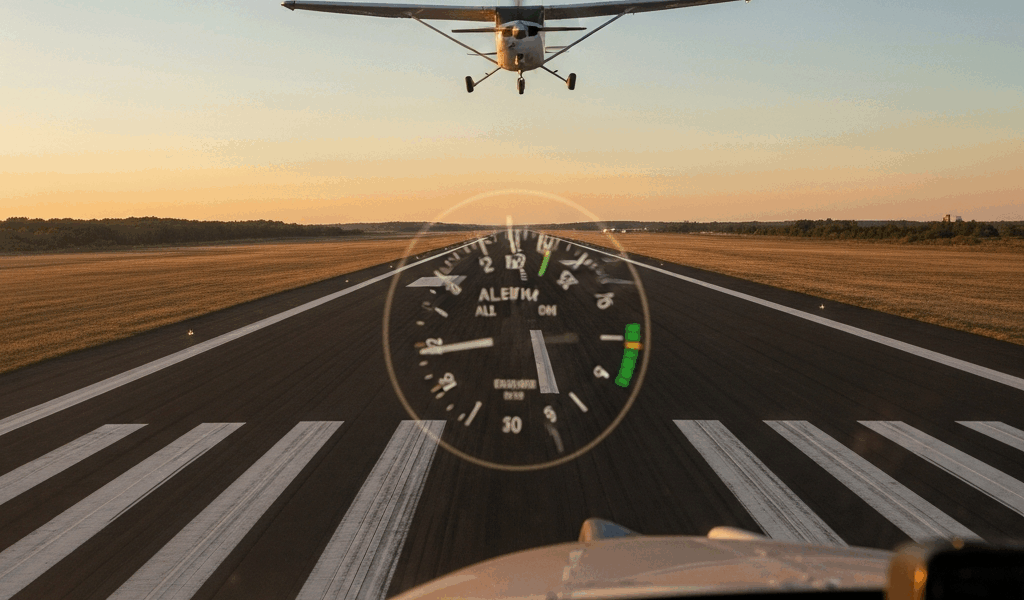
The Pattern Feels Different When No One Is Sitting Next to You
Solo pattern flying has evolved with all the conflicting advice flying around — “just trust your training,” “the pattern is the pattern,” “you’ve done this twenty times already.” Sure. And yet the downwind leg on your first solo will feel like it’s moving at twice the speed it ever did with your CFI in the right seat. I promise you that.
As someone who white-knuckled through a first solo pattern at a busy uncontrolled field on a gusty Tuesday afternoon, I spent months getting comfortable with why that feeling happens. Today, I will share it all with you.
Quick note before the rest of this — because understanding that the “everything is faster” sensation is real, universal, and neurologically explainable does more for pre-solo nerves than any checklist ever printed. Your CFI closing that door doesn’t change the wind. Doesn’t change the runway numbers. Doesn’t add a single knot to the pattern speed. What it removes is the psychological governor. Someone else was there. If you drifted, they’d say something. That safety net disappears, and your brain — quite reasonably — responds by feeling rushed.
Cognitive load theory calls this working memory throttling. You’re juggling airspeed, altitude, heading, radio calls, and the visual geometry of the rectangle you’re flying — all of it now at higher perceived stakes. That’s not twenty tasks. That’s twenty tasks with no backup. Students consistently report the turn from downwind to base arriving in half the time it did during dual instruction. The clock disagrees. Their perception doesn’t care.
So name it before you fly. You’re going to feel fast on downwind. That feeling is information — not proof you’re failing.
Turning Base Too Late Is the Most Common Pattern Error
Every CFI sees it on repeat: student stays on downwind just a hair too long, overshoots final, then S-turns or slips to realign. First solo, second solo, sometimes the thirtieth. It’s the most consistent mistake in pattern flying, and it comes from three places the Airman Certification Standards don’t mention.
First — the visual illusion built into downwind. Looking at the runway perpendicular to your flight path gives your brain almost zero depth information. You’ve spent your whole life judging distance by looking at things head-on. Sideways? The runway reads as farther away than it actually is. So when the turn should happen, it still feels early. You wait.
Second — wind compounds everything. On downwind you’ve got a tailwind cooking your ground speed. Roll onto base into a headwind and ground speed drops — airspeed unchanged, but the visual rate of approach shifts. Instructors coach you through this. Alone, you’re flying on instinct that hasn’t absorbed that lesson yet.
Third — doubt. Your hand hovers over the yoke for the last thirty seconds of downwind. Should I turn now? What if the angle is wrong? That hesitation is just long enough to blow the entry. You’re committed to base with a wider radius than you wanted, and now you’re correcting instead of flying.
Here’s the concrete fix: stop waiting for a “feels right” moment. Instead, pick something specific on the runway — not the numbers, something more precise. At a 5,000-foot runway like the one I trained on, I used the Runway 27 hold-short intersection as my reference. When that landmark stops appearing to move away from your wingtip and starts moving toward it, start the turn. That gives your brain a visual event to respond to instead of an abstract judgment call.
That’s what makes a concrete visual cue so endearing to us student pilots. It replaces a guess with a trigger.
Altitude and Airspeed Fall Apart at the Same Time
But what is task saturation in a pattern context? In essence, it’s the moment your brain picks one instrument to stare at and quietly ignores everything else. But it’s much more than that — it’s the specific mechanism behind most first-solo altitude deviations.
On downwind and base during dual instruction, your CFI is taking small bites of the workload. You fly the heading; they monitor altitude. Alone, your scan has to cover everything — and under stress, scans collapse into fixations. You lock onto the altimeter because altitude feels dangerous. Airspeed bleeds. Or you lock onto the airspeed indicator because Vref got drilled into you, and you descend 200 feet without noticing.
I’m apparently an altimeter-fixator, and a disciplined scan works for me while “just fly by feel” never does. Steer clear of where I went wrong of assuming you know which one you’ll fixate on — find out during dual instruction before the solo.
Prioritize like this: on downwind and base, altitude is non-negotiable. 1,000 feet AGL, full stop. Trim it in and trust the elevator to hold it. Airspeed on downwind should run around 1.3 times Vs — for a Cessna 172 at normal training weight, that’s roughly 65 knots. Then on final, manage the slowdown to Vref. Not before. Vref for the same 172 runs 55 to 60 knots depending on configuration and weight — check your POH for your specific aircraft.
The order matters because altitude is only recoverable if you have airspeed to recover with. A student low and slow can’t climb out of trouble. A student high but fast can forward-slip down. Airspeed is the foundation. Altitude is built on top of it. Never backwards.
Radio Calls Break the Scan and Nobody Warns You
The radio workload spike hits hardest on base-to-final. Worst possible moment. You’re configuring flaps, cross-checking altitude, rolling out on final — and now you need to announce short final to traffic that may or may not be out there. Your eyes go to the radio. Your scan stops. Ten seconds pass. That’s a lot of feet on short final.
During dual instruction, your CFI handled the radio. You just flew. Solo, there’s no division of labor anymore.
The fix is almost embarrassingly simple: script every call before you leave the ramp. Not a mental note — an actual pre-built phrase, anchored to a specific physical event. Abeam the numbers on downwind: “Cessna 172, November 4-4-7-Sierra-Papa, midfield downwind, Runway 27, touch-and-go.” Turning base: shorter call. Rolling out on final: short final call. The call stops being a task-in-the-moment that steals your eyes. It becomes a line you already know, delivered and done.
A missed call is always better than a call that costs you 150 feet of altitude awareness on short final. Seriously — every time.
How to Rehearse the Solo Pattern Before You Ever Leave the Ramp
Chair flying works — but only if you match the specificity of the real task. Generic rehearsal helps a little. Here’s the version that actually sticks:
- Verbalize every control input. Sit in the left seat, hand on the yoke, and announce everything aloud: “Rolling left to downwind. Throttle to 1,500 RPM. Trimming for 65 knots. Altitude check — 1,000 feet.” Speaking engages different neural pathways than silent mental rehearsal. The difference is noticeable on the real flight.
- Anchor radio calls to physical positions. “Abeam the runway — I say ‘Cessna 7SP, midfield downwind, Runway 27.’ Turning base — shorter call. Rolling out on final — short final.” Each phrase tied to an action, not a moment of decision.
- Practice the overshoot recovery. Because you will overshoot final on your first solo — or come close. Know now what you’ll do: shallow bank correction, forward slip if needed, or go-around. The go-around decision especially needs to be pre-made. Deciding under stress is slow. Executing a pre-made decision is fast.
- Use a timer. Set a phone timer for five to eight minutes — roughly the duration of one pattern at 90 knots with a light wind. Fly the entire chair sequence against that timer. Your brain starts to calibrate what the pacing should feel like, which directly counteracts the “everything is faster” illusion on the real solo.
So, without further ado, let’s be honest about what separates a sloppy first solo pattern from a clean one: it’s not talent. It’s not even hours. It’s rehearsal of the actual task — downwind while managing workload, base while staying calm, final while executing, radio calls already scripted. Students who do this specific preparation consistently fly cleaner first solos. The ones who just “trust their training” and skip the chair work are the ones S-turning back to centerline at 300 feet AGL.
This new approach to pre-solo preparation took off among serious flight instructors several years ago and eventually evolved into the structured chair-flying methodology CFIs know and recommend today. It’s not glamorous. It’s sitting alone in an airplane on the ramp, talking to yourself. Do it anyway.

Stay in the loop
Get the latest skyhighflighttraining updates delivered to your inbox.