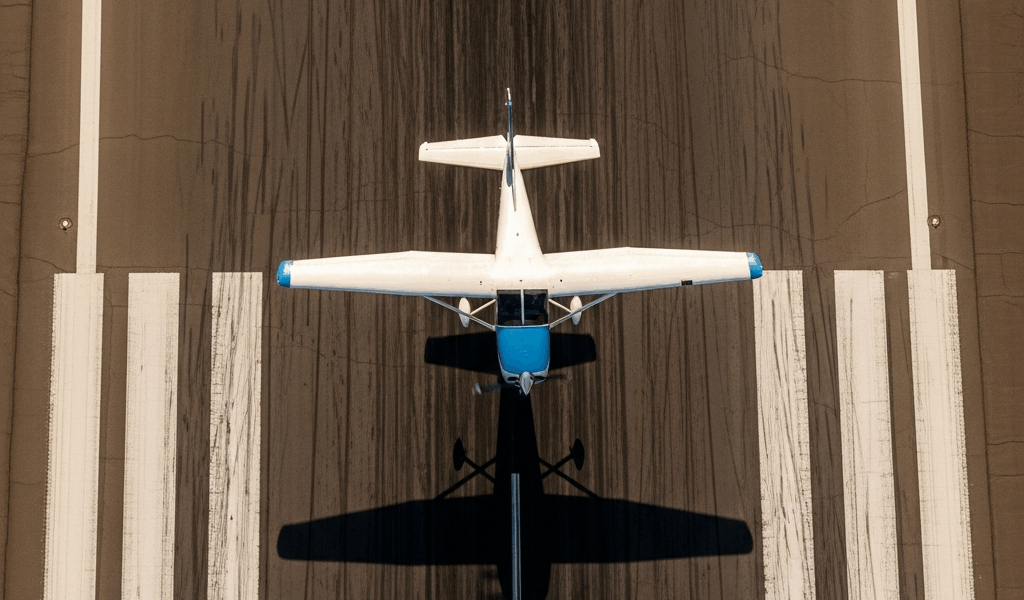
Why Student Pilots Struggle With Crosswind Landings
Crosswind landings have turned into a moving target with all the conflicting advice flying around — forums saying one thing, instructors saying another, YouTube videos confidently contradicting each other. As someone who spent weeks genuinely baffled by this maneuver, grinding through approach after approach at a windy grass strip near Salinas, I dug into the practical details of what actually breaks crosswind technique. Today, I will share it all with you.
The core problem is simple but brutal: the correction sequence feels backward to your instincts. Wind is pushing you sideways, your reflexes say lean into it, and that impulse — completely natural, completely wrong — is exactly what kills most crosswind approaches before you ever reach final. My CFI, Tom, watched me blow approach after approach without saying much. Which somehow made it worse. Then one afternoon he finally broke down what I was doing wrong. Not one thing. Three specific moments where my inputs fought the airplane instead of working with it.
What Usually Goes Wrong Before You Even Reach Final
Most students don’t start correcting for wind on base. They fly a normal approach, roll out onto final, and suddenly notice the runway drifting sideways beneath them. That’s already too late.
By the time you’re established on final, you’re committed. Maybe 500 feet to fix a mistake that started two turns ago. Wind correction has to begin the moment you turn base — at least if you want any real margin to work with. Twelve-knot wind from the left? You need a crab angle established while you’re still turning, before you’re fully aligned with the runway.
Most students either ignore this completely and drift until final — panic territory — or they nail a crab angle and then freeze. Hold it all the way down. It feels stable. It feels controlled. It’s also about to cause a sideways landing. That’s the trap nobody warns you about clearly enough.
The Crab vs. Slip Confusion That Throws Everyone Off
Quick note before the rest of this, because this is where the real disconnect lives.
But what is a crab angle? In essence, it’s pointing the nose slightly into the wind so your groundtrack stays straight down the centerline. But it’s much more than that — it’s a temporary tool, not a landing technique. From the tower it looks fine. In the cockpit it feels stable. The airplane isn’t getting pushed around.
You cannot land in a crab. Wheels touching down sideways means uneven loading on the gear, the airplane wanting to skip, tire wear the Cessna 172 never signed up for. Think driving a car sideways into a parking space. Works fine until pavement.
So somewhere between 50 and 20 feet, you transition — crab becomes a slip. Lower the upwind wing. Point the nose back down the runway with opposite rudder. Accept that the airplane now feels like it’s being shoved sideways. Because it is. But now your fuselage is aligned with your direction of travel, and the wheels will touch down straight.
That transition is exactly where students get stuck. You’ve been holding the crab and feeling stable. Now you’re tilting the airplane, feeding in rudder, and suddenly everything feels less controlled, not more. The wind seems stronger. Your brain is screaming that something is wrong.
It’s not. That queasy feeling is just your instinct arguing with correct technique. The slip is supposed to feel different. A little weird. Less smooth. That’s how you know you’re doing it right. That’s what makes crosswind technique endearing to us student pilots — it only starts making sense after it stops feeling catastrophic.
Why Dropping the Upwind Wing Too Fast Makes It Worse
Once you commit to the slip, new students almost always make the same move: they dump the aileron.
Bank angle jumps from zero to 8 or 10 degrees in maybe two seconds. The nose swings. Everything moves at once. The airplane stops slipping and starts crabbing again — or worse, starts drifting. Learn from what tripped me up.
What actually needs to happen is coordinated input. Aileron into the wind to lower the wing, yes, but simultaneous opposite rudder to prevent the nose from following the bank. Wind from the left means left aileron and right rudder at the same time, in amounts that match each other. It’s like playing two instruments simultaneously — neither one can just do whatever it wants.
The proportion matters more than the amount. Fifteen-knot crosswind, you might be using roughly 5 degrees of aileron and 8 degrees of rudder. Twenty-knot wind, maybe 7 and 12. No formula exists — you’re feeling it, dialing it in, micro-adjusting as the wind gusts or smooths out. Dumping the aileron breaks that balance immediately.
Tom used to say, “Paint it in, don’t pour it in.” That stuck with me. The correction should feel gradual, intentional — like adding ingredients to a recipe, not dumping a bucket. The wing comes down smoothly. The nose stays painted on the runway numbers. If the nose is hunting left and right, your rudder is chasing the aileron instead of leading it.
Rudder Discipline From Flare to Full Stop
Where most crosswind landings actually break is in the last 10 feet.
You’ve nailed the slip. Wing is down. Nose is straight. Groundspeed is good. Then the flare happens and everything suddenly feels delicate — so you ease off the rudder. That’s the mistake. This is when you need more rudder, not less.
The goal is having the upwind main wheel touch first. Not both wheels simultaneously. The upwind wheel kisses pavement just before the downwind wheel makes contact. That single detail tells you the fuselage is truly aligned with the runway — the wind isn’t going to push you sideways after landing.
I’m apparently wired to relax inputs at the worst possible moment, and fighting that impulse through the flare works for me while just letting it happen never does. You’re flaring with a wing down and opposite rudder fed in, and your instinct says the airplane is about to tip or veer. It won’t. The slip is the correction. Relaxing it is the mistake.
Carry that rudder input all the way through touchdown and into rollout. As wheels settle and you’re rolling straight, gradually release the aileron — wind cares less about bank angle once tires are on the ground. But the rudder? Hold it until you’ve got positive forward motion and the nosewheel is tracking straight. Not before.
How to Practice This Without Perfect Wind Conditions
So, without further ado, let’s dive into what actually builds this skill — because honest answer first: you can’t fully practice crosswind landings without crosswind conditions. But you can build the motor pattern at home.
Chair-fly the transition. Sit in your living room and physically go through the motions. A pencil works as your yoke — I used a 12-inch wooden ruler, which felt ridiculous and worked perfectly. Establish an imaginary crab. Lower one hand for aileron, opposite foot for rudder, both at once, both smooth. Do this five times a night for a week before your next flight. Your hands remember the sequence before the airplane ever needs it.
Ask your CFI for a dedicated crosswind session — at least if you actually want to compress the learning curve. Not a lesson crammed between three other maneuvers. A full flight focused on landings. Grass strips often have better crosswind runways than paved fields. A 15-knot wind at a 30-degree angle beats waiting for the one-in-ten day when you get a perfect 20-knot direct crosswind.
A simulator might be the best option, as crosswind practice requires repetition without consequence. That is because resetting after a bad landing takes seconds instead of 20 minutes of taxiing and climbing back to pattern altitude. A Redbird or Elite simulator runs somewhere around $75–$100 per hour depending on location. Thirty minutes of nothing but crosswind transitions will compress weeks of random practice. You’ll feel the inputs, see the results, reset, and do it again — without worrying about tire wear or your instructor’s blood pressure.
Crosswind landings click after deliberate practice, not more theory. You understand the mechanics now. Next part is just flying them.


Stay in the loop
Get the latest skyhighflighttraining updates delivered to your inbox.