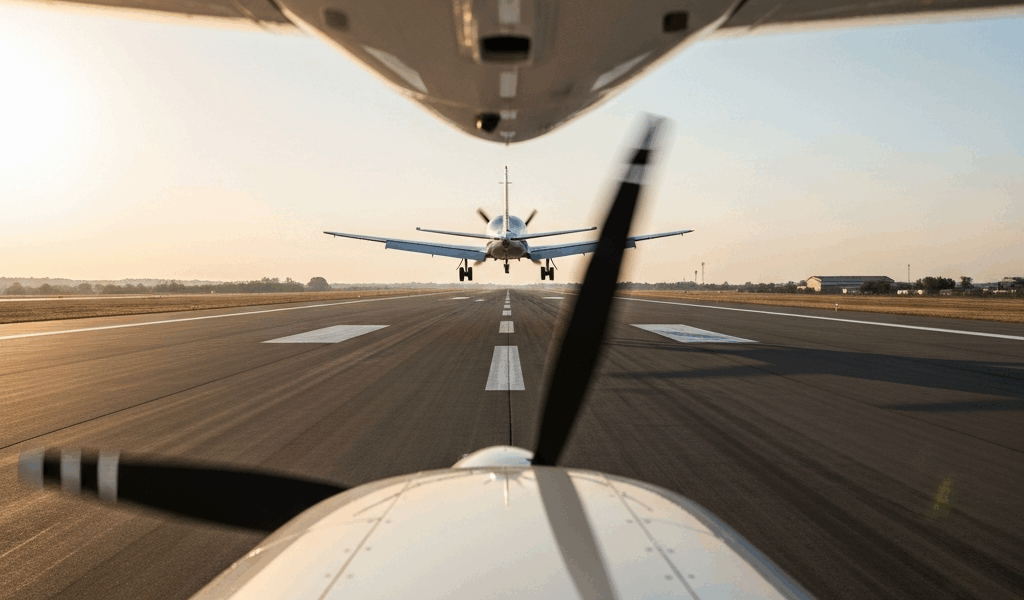
What a High Flare Actually Looks Like
Landing has gotten less clear-cut with all the conflicting advice flying around. Flare at fifty feet. Watch your altimeter. Feel the ground effect. Everyone’s got a technique, and somehow none of it clicks until you’ve floated past the numbers for the fourteenth time wondering what went wrong.
You’re three hundred feet above the runway. Everything feels right — descent rate stable, airspeed where it should be. Then something shifts. You pull back on the yoke, maybe gently, maybe harder than intended, and the nose rises. But the wheels don’t touch. The runway keeps sliding underneath you. Fifty feet. Forty. Thirty. The stall warning horn starts chirping. Your stomach figures it out before your brain does.
That ballooning sensation — the aircraft climbing when it should be descending — wrecks more student landings than almost anything else. Not because those students are careless. Not because they haven’t practiced. The visual signals they’re using to time the flare are simply lying to them. They initiated the flare based on a number, or a memory of what fifty feet looked like on some previous flight, not what the runway was actually showing their eyes right then.
This is the piece to know up front. You’re not alone in this. I’ve sat in the right seat while students flared at eighty feet, one hundred feet, even one hundred twenty feet — the experienced ones, the ones with two hundred hours logged. It’s the most common plateau in primary training, and repetition alone doesn’t fix it.
The Real Reason Your Eyes Are Fooling You
Here’s what actually happens during the transition from final approach to ground effect.
On final — say, two thousand feet above ground — your sight line from the cockpit window is shallow and stable. The runway is a distant rectangle. You’re using landmarks, the threshold, maybe a VASI or PAPI to judge your descent. Depth perception works normally because distance references exist everywhere around you.
At four hundred feet, the sight line steepens. The runway looks bigger but stays distant enough that peripheral vision still provides solid spatial cues.
Then, somewhere between one hundred fifty and one hundred feet, something changes dramatically. The cockpit perspective shifts hard. The runway fills your entire forward view. The sight line becomes nearly vertical. Distance references vanish. The runway stops looking like a rectangle — it looks like a floor beneath you.
That’s the depth perception shift. Your brain hasn’t built a mental model for this perspective yet. It’s unfamiliar. Unsettling. And if you’re relying on how high you think fifty feet looks, you’re going to be wrong — because you’ve never actually looked at fifty feet from this exact angle in this exact aircraft before.
Switching aircraft types makes it dramatically worse. A Cessna 172 has a sight line from the left seat that’s nothing like a Piper Cherokee or a Diamond DA40. The cowling length varies. The windscreen angle changes. I’m apparently a 172 pilot and that sight picture works for me while the Cherokee never quite clicked — took me three sessions to stop flaring six feet too high in it. A student who’s done forty landings in one airframe moves to another and suddenly flares completely differently, not because their skill changed, but because the visual input is literally different. Learn from what tripped me up of assuming aircraft transitions are minor adjustments.
Three Specific Mistakes That Cause the High Flare
Mistake 1: Flaring by Altitude Instead of Sight Picture
But what is a sight-picture flare? In essence, it’s timing your pitch input based on what the runway visually shows you rather than what a number says. But it’s much more than that — it’s training your eyes to read pavement texture, edge line sharpness, and runway detail as a real-time altitude instrument.
You’ve been told to flare at fifty feet, so you check the altimeter at fifty feet and start pulling back. This fails because altimeters lag at low altitude — they’re simply not precise enough down there. And fifty feet looks nothing like what you’d expect when you’re actually that close to the ground.
The fix: ignore altitude numbers entirely during the final thirty seconds of descent. Watch the runway surface itself. The pavement texture changes as you get lower. Edge lines become distinct. When you can make out actual asphalt grain — or read the paint details on the centerline — that’s your cue to begin the flare. Not a number on a dial.
Mistake 2: Pulling Back Too Hard, Too Fast
Anxiety accelerates everything. You’re nervous, you pull back aggressively to arrest the descent, and you balloon immediately. The aircraft climbs instead of floating.
The correction is physical and deliberate. Picture your right hand making tiny, incremental movements — almost embarrassingly small. For every five feet of descent, add one small backward movement of the yoke. You want a gradual pitch-up, not a sudden one. Descent rate should decrease inch by inch. If you’re pulling hard enough to feel real resistance in your arm, that’s too hard. Full stop.
Mistake 3: Staring at Your Nose Instead of the Horizon Line
Students fixate on the cowling. They watch the nose rise and assume the flare is working. It’s not — a rising nose can mean a lot of things, and most of them end in a balloon or a bounce.
Watch the far end of the runway instead. Pick a point roughly three thousand feet down the pavement. That point should stay level or drop slightly as you flare. If it’s rising, you’re pulling back too much. If it holds level while your descent rate slows, the flare is correct. That’s what you’re after.
Drills Your Instructor Can Run With You Right Now
While you won’t need specialized equipment or a simulator, you will need a handful of deliberate practice sessions structured differently than your usual pattern work.
Low Approaches Without Landing
First, you should ask your CFI to run five consecutive low approaches without actually landing — at least if you want to break the psychological pressure cycle. Descend to five feet, flare, level off about two feet above the surface, then climb out. Repeat five times. It removes the “I have to land this” urgency entirely and lets you focus purely on sight picture and physical feel. After five of these, actual landings feel genuinely less desperate.
Slow Flight in Ground Effect
Request thirty minutes of slow flight — full-flap, deliberately slow — while staying between five and twenty feet above the runway. Fly the full length of the pavement at minimal airspeed. This teaches you what the sight picture looks and feels like when you’re genuinely low, normalizes the view, and builds muscle memory for the control pressure needed at those speeds. That’s what makes this drill endearing to student pilots who’ve tried everything else — it’s uncomfortable at first, then suddenly clicks.
Verbalized Flare Timing
On your next approach, talk out loud the entire way down. “Two hundred feet, scanning the runway. One fifty, texture starting to sharpen. One hundred, edge lines distinct. Fifty, flare starting now.” Speaking forces your brain to slow down. It segments the approach into distinct phases instead of one blurry, anxious descent. Your CFI can hear exactly when you’re misreading the visual cues — which makes this probably the fastest diagnostic tool available to both of you. So, without further ado, try it on your very next flight.
How You Know the Flare Is Actually Fixed
A correct flare feels like floating. Not ballooning. Floating.
Descent rate decreases to roughly fifty feet per minute. The runway surface is clearly visible beneath you. The nose rises gradually — not suddenly. Mains touch down first, always, with the nosewheel still two or three feet off the pavement when they do. No chirping stall warning. No bounce. Just a quiet, gradual arrival at maybe sixty to seventy knots depending on your aircraft’s Vref.
Self-check for your next flight: descent rate steady until two hundred feet, runway texture visible before the flare begins, nose rise gradual and smooth, mains down before nosewheel, normal landing distance used. Hit those four marks consistently and the flare is fixed — genuinely fixed, not just getting lucky.
The flare is not a talent. It’s a learned visual skill. Your eyes and hands can absolutely be trained to do this correctly, and now you know exactly what to train them on.

Stay in the loop
Get the latest skyhighflighttraining updates delivered to your inbox.