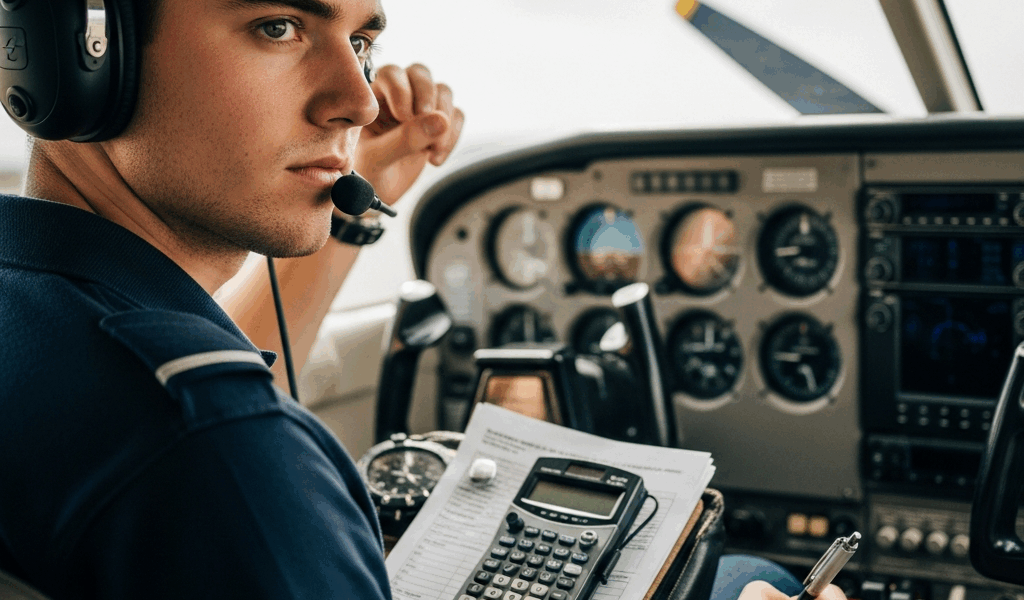
Your CFI just told you to compute weight and balance for a cross-country flight with three passengers and full fuel, and you are staring at a blank sheet trying to remember what goes where. Weight and balance is one of those checkride topics that trips up student pilots because it seems like pure math — until you realize the math tells you whether your airplane can actually fly safely. Here are worked problems that walk through the process the way you will do it in the cockpit and on your oral exam.
How Weight and Balance Works (The 60-Second Version)
Every item in the airplane — pilot, passengers, fuel, baggage — has a weight and a position (arm) measured in inches from a reference point called the datum. Multiply weight times arm and you get the moment. Add up all the moments, divide by the total weight, and you get the center of gravity (CG) location. The CG must fall within the envelope published in the Pilot Operating Handbook (POH) for the airplane to be safe to fly.
If the CG is too far forward, the airplane requires excessive back pressure to flare for landing and the elevator may not have enough authority to raise the nose. If the CG is too far aft, the airplane becomes increasingly unstable — pitch inputs are amplified, stall recovery becomes difficult, and in extreme cases the airplane becomes uncontrollable. Both conditions are dangerous. The CG envelope exists because the airplane was only tested and certified for flight within those limits.
Problem 1: Cessna 172 — Two Passengers, Full Fuel
Given:
Basic empty weight: 1,663 lbs at moment 63,894 in-lbs
Pilot (front left): 180 lbs at arm 37
Front passenger: 155 lbs at arm 37
Rear passengers: none
Fuel: 53 gallons (full) at 6 lbs/gal = 318 lbs at arm 48
Baggage: 30 lbs at arm 95
Solution:
Empty aircraft: 1,663 lbs x moment = 63,894
Pilot: 180 x 37 = 6,660
Front passenger: 155 x 37 = 5,735
Fuel: 318 x 48 = 15,264
Baggage: 30 x 95 = 2,850
Total weight: 1,663 + 180 + 155 + 318 + 30 = 2,346 lbs
Total moment: 63,894 + 6,660 + 5,735 + 15,264 + 2,850 = 94,403 in-lbs
CG = 94,403 / 2,346 = 40.24 inches aft of datum
Check: Maximum gross weight for a Cessna 172S is 2,550 lbs — we are at 2,346, under the limit. The CG envelope for a 172S at this weight runs approximately 35 to 47 inches aft of datum. Our CG at 40.24 is well within limits. This loading is legal and safe.
Problem 2: Four Passengers, Weight Limit Check
Given:
Basic empty weight: 1,663 lbs at moment 63,894
Pilot: 200 lbs at arm 37
Front passenger: 185 lbs at arm 37
Rear left: 170 lbs at arm 73
Rear right: 165 lbs at arm 73
Fuel: 53 gallons = 318 lbs at arm 48
Baggage: 50 lbs at arm 95
Solution:
Total weight: 1,663 + 200 + 185 + 170 + 165 + 318 + 50 = 2,751 lbs
Stop here. Maximum gross weight is 2,550 lbs. We are 201 lbs over. This loading is illegal regardless of where the CG falls. The airplane cannot legally take off at this weight.
The fix: reduce fuel. 201 lbs / 6 lbs per gallon = 33.5 gallons less fuel. That leaves 19.5 gallons — about 1.5 hours of flight time with reserve. Alternatively, leave the baggage behind (saves 50 lbs) and reduce fuel by 25 gallons (150 lbs), bringing total to 2,551 — still one pound over. The practical solution with four adults in a Cessna 172: reduce fuel to 30 gallons (180 lbs of fuel, saving 138 lbs) and carry 20 lbs of baggage (saving another 30 lbs). New total: 2,583 — still over. With four adults averaging 180 lbs each, a fully loaded 172 almost always requires reduced fuel. Run the numbers every time.
Problem 3: Aft CG Scenario
Given:
Basic empty weight: 1,663 lbs at moment 63,894
Pilot: 140 lbs at arm 37
Front passenger: none
Rear left: 200 lbs at arm 73
Rear right: 190 lbs at arm 73
Fuel: 30 gallons = 180 lbs at arm 48
Baggage: 100 lbs at arm 95
Solution:
Total weight: 1,663 + 140 + 200 + 190 + 180 + 100 = 2,473 lbs (under max gross — good)
Moments: 63,894 + 5,180 + 14,600 + 13,870 + 8,640 + 9,500 = 115,684
CG = 115,684 / 2,473 = 46.78 inches
Check: weight is under the limit, but the CG at 46.78 inches may be at or near the aft limit of the envelope. In a Cessna 172S, the aft CG limit at this weight is approximately 47.3 inches — we are within limits but very close to the aft boundary. This is a scenario your DPE will test on your oral exam: the weight is fine but the CG is dangerously far aft.
The fix: move weight forward. Have one rear passenger move to the front right seat. That moves 190 lbs from arm 73 to arm 37, shifting the CG significantly forward. Or reduce baggage — 100 lbs at arm 95 is pulling the CG aft hard. Drop baggage to 40 lbs and recalculate.
Checkride Tips for Weight and Balance
Your DPE will give you a scenario and expect you to compute it accurately, explain what the numbers mean, and describe what you would do if the loading is out of limits. Practice until the math is automatic, because the oral exam is not the place to fumble with a calculator.
Always check weight first, then CG. If the weight exceeds max gross, the CG calculation is irrelevant — the airplane is over gross and cannot fly regardless. Checking weight first saves time and avoids computing a CG for an illegal loading.
Know the limitations of the loading graph versus the calculation method. Some POHs provide a loading graph where you plot weight and moment directly without computing CG in inches. Both methods give the same answer — your DPE may ask you to do it both ways.
Remember that fuel burns during flight. A loading that starts within the envelope can shift as fuel is consumed. Compute the CG at takeoff weight and at landing weight (after expected fuel burn) to ensure it stays within the envelope for the entire flight. If the CG is near the aft limit at takeoff and fuel burns from arm 48 (forward of the CG), the CG moves further aft during flight. This is a checkride trap — the DPE will ask about CG shift during flight.

Stay in the loop
Get the latest skyhighflighttraining updates delivered to your inbox.