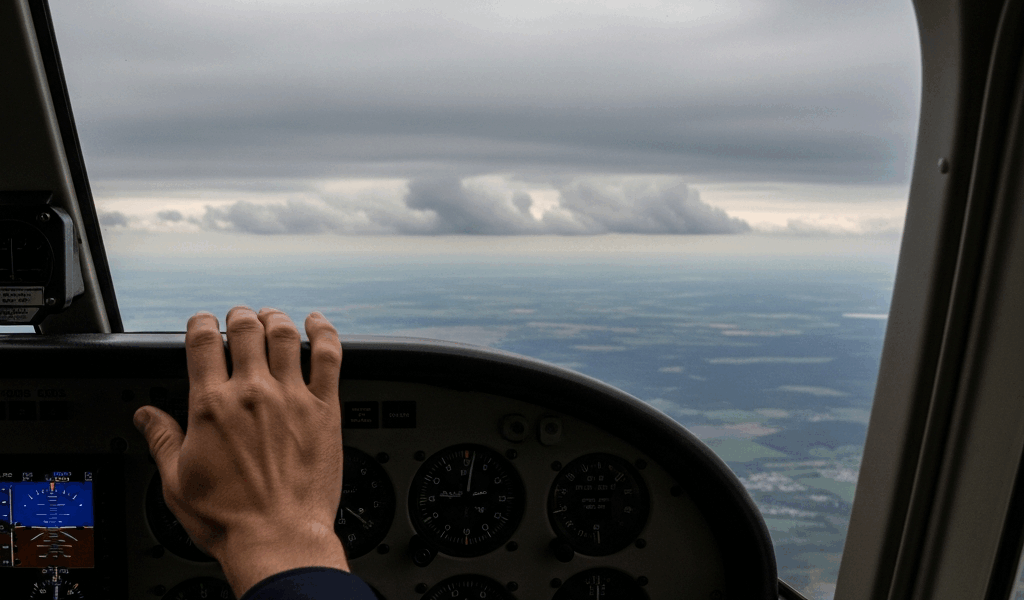
Why VFR into IMC Kills Experienced Pilots Too
VFR into IMC has gotten complicated with all the mythology flying around — mostly the myth that it’s a student pilot problem. It isn’t. I’ve read accident reports involving 1,500-hour regional captains. Part-time corporate pilots with spotless records. People who knew better. The common thread was never incompetence. It was pressure, every single time.
Get-there-itis is a real neurological condition wearing judgment as a costume. A charter pilot eyeballs an undercast that looks “thin enough.” A physician flying home after a double shift decides the briefer was being conservative. A CFI with a student in the right seat convinces himself he can climb above it — just this once. The decision point feels reversible in the moment. It almost never is.
Probably should have opened with this section, honestly. Deteriorating VFR doesn’t announce itself with a warning horn. Cloud layers don’t materialize suddenly at your altitude. Visibility doesn’t cut out like a switch being thrown. The horizon softens first. Then shadows flatten. Then contrast just — evaporates. By the time your brain registers “this is IMC,” the exit has already closed behind you. Understanding that threat profile is half the survival equation.
How Spatial Disorientation Actually Develops in the Cockpit
Your inner ear has a fluid-filled structure called the vestibular apparatus. On the ground it’s remarkably precise. Inside a cloud, it becomes a pathological liar.
The instant you enter solid IMC without visual references, the vestibular system has nothing left to calibrate against. Fluid in your semicircular canals keeps moving from your last intentional input — a shallow turn, a gentle climb, a small descent correction. Your brain reads that residual fluid motion as ongoing movement, even after the maneuver has stopped. That’s the leans illusion. You’re wings-level. Your body is absolutely, bone-deep certain you’re in a 15-degree bank.
So you make a small correction. A little nudge of the yoke to “fix” the bank your body is screaming about. Except you’re now actually beginning a turn. The vestibular system — still convinced you were already banked the other direction — reinforces its original lie. The turn tightens. You keep correcting. Ninety seconds later you’re in a classic graveyard spiral. The instruments are screaming. Your body insists everything is completely normal.
Here’s the thing that actually kills pilots: the instruments don’t feel ambiguous. They feel wrong. Altimeter unwinding. Airspeed climbing past Vno. VSI pinned in a descent. Attitude indicator showing a 40-degree bank. All of it directly contradicts the absolute physical certainty that you’re level. Most pilots trust their bodies. That’s the last mistake they make.
Recovery requires overriding roughly a million years of evolutionary wiring. Not impossible — but it demands a decision made before you ever entered that cloud: I will believe the instruments. Not my body. The instruments.
The First 30 Seconds — What to Do When You Enter IMC
You’re flying a Cessna 172, cruising at 2,000 feet MSL. Visibility ahead collapses to maybe half a mile. The horizon dissolves into uniform gray. You’re in IMC. Now what?
- Name it out loud immediately. Say the words: “I’m in IMC.” Not in your head — out loud. The moment you accept you’ve lost visual references, your entire scan pattern has to change. Saying it forces that cognitive shift. This is not failure. This is adaptation.
- Level the wings first — before anything else. Eyes to the attitude indicator. Bank showing? Use ailerons to bring the wings back to the horizon line on the instrument face. Do this right now. Everything else waits.
- Climb to a safe altitude immediately. You entered at 2,000 feet. Terrain in your area might sit at 1,400. You don’t actually know your precise obstacle clearance. Climb — 3,000, 4,000, whatever gives you real breathing room. Use a steady pitch attitude and a known power setting. Smooth inputs only. No aggressive maneuvering.
- Run the instrument cross-check in sequence. Attitude indicator, airspeed, altitude, vertical speed, heading — then repeat. Your job isn’t to absorb everything simultaneously. Your job is to keep reading in sequence and making small, deliberate corrections. Tiny inputs.
- Pick a heading toward known VFR or hold your current one. If you know where clear air is, fly toward it. If you don’t, maintain a heading and declare an emergency with ATC. Do it now, not in five minutes. Controllers will work with you. That’s what they’re there for.
- Do not attempt a visual 180-degree turn. The turn will deepen your disorientation. If you’re going to turn back, execute it on instruments — deliberate, coordinated, instrument-referenced. You can turn safely on instruments. You absolutely cannot turn safely on feel alone.
This sequence takes about 30 seconds if you’ve actually practiced it. It takes closer to 30 minutes if you haven’t — and 30 minutes is almost certainly more time than your altitude and terrain will give you.
How to Recognize Deteriorating VFR Before You Are Trapped
Prevention beats recovery. Every single time, no contest.
The horizon is your earliest warning system. In genuine VFR, you see a sharp, clean line between earth and sky. As visibility drops, that line softens. Gets fuzzy. Then it disappears into uniform gray or white. If you’re staring at a soft horizon and wondering whether you’re still legal — you aren’t. Turn back now, while you still have altitude and options both.
Shadows go next. Objects cast shadows in clear air, and your brain uses that shadow data constantly for depth perception. Below roughly 3 miles visibility, shadows fade. Terrain flattens out and loses dimension. Your depth perception is already degraded. That’s your two-minute warning, not a suggestion.
Contrast between terrain types collapses last. A tree line stops standing out from the forest behind it. A county road fades into surrounding fields. At that point your visual navigation capability is already compromised — not weakened, compromised. Turning back at this stage means climbing to a safe altitude first, then executing a structured, instrument-referenced 180. Not eyeballing it.
Set personal minimums before you ever leave the ramp. Legal minimums are 1,000-foot ceiling and 3 statute miles. Don’t touch those numbers. I’m apparently conservative about this — 1,500 feet AGL and 5 miles is my actual floor, and it’s worked for me while flying to the legal edge never has. If forecasts or METARs are approaching those thresholds, stay home. File IFR. There’s no schedule worth it. There isn’t one.
Practical Ways Student Pilots Can Train for This Scenario
Hood time with a CFI is non-negotiable — at least if you plan to fly anywhere weather exists. I logged eight hours wearing foggles during primary training. Those eight hours have probably saved me on at least two separate occasions. Don’t make my mistake of treating it as a checkride box to check.
During hood work, your instructor blocks most of your outside visual reference so you’re flying exclusively on the panel. You’ll run basic attitudes — straight and level, climbs, descents, standard-rate turns — using only instruments. Your vestibular system will revolt. It will insist the instruments are lying. You’ll learn, through repetition, that they aren’t. That learning becomes something close to reflex when you’ve reinforced it enough times.
Practice the cross-check until it’s genuinely automatic. Attitude indicator, airspeed, altitude, vertical speed, heading — repeat. During regular VFR flights, run this scan with your eyes even when you don’t need it. Build the neural pathway before you need it under pressure.
Simulator sessions typically run $60 to $100 per hour depending on the equipment — a Redbird FMX or Frasca 141 will humble you faster than the actual airplane will. That’s the point. Losing control of a simulator is embarrassing. Losing control of an actual airplane in IMC is fatal. Sim time specifically teaches you to stay functional while disoriented, and you will be disoriented.
Basic attitude instrument flying is on every private pilot checkride. Most VFR pilots let those skills decay within six months of getting the certificate. Annual hood refresher work costs less than one fuel surcharge and pays back tenfold the first time you accidentally punch through a cloud layer.
That’s what makes the instrument rating endearing to us VFR pilots who fly in genuinely variable conditions — coastal marine layer, mountain passes in October, anywhere weather moves fast. The rating itself isn’t the product. The competence and genuine confidence built during training is. An instrument rating forces you to master exactly the skills that keep you alive in inadvertent IMC. If you regularly fly marginal conditions, that’s honest CFI advice, not a sales pitch.
VFR into IMC is survivable. Thousands of pilots have walked away from it — because they’d practiced the right responses before the emergency arrived. You can absolutely be one of them.



Stay in the loop
Get the latest skyhighflighttraining updates delivered to your inbox.