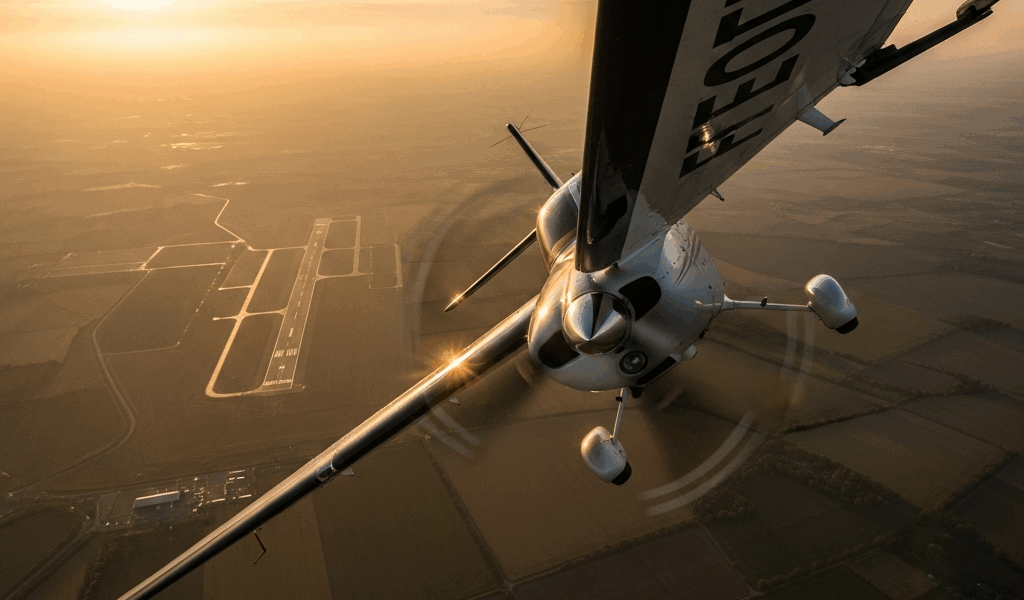
Why They Call It Impossible — The Physics
The impossible turn has gotten complicated with all the myth and bravado flying around. Every pilot has an opinion. Half of them are wrong in ways that could kill you.
As someone who has taught hundreds of student pilots through engine-failure scenarios, I learned everything there is to know about turnback attempts — most of it the hard way, watching students nearly kill themselves in simulators and, twice, in actual aircraft. Today, I will share it all with you.
But what is the impossible turn? In essence, it’s the attempt to reverse course after an engine failure on takeoff and return to the departure runway. But it’s much more than that. It’s a physics problem disguised as a survival instinct — and your instincts are wrong about it.
Here’s what actually happens in a standard Cessna 172 during that desperate turn. You’re at 400 feet AGL, climbing at best angle — around 700 feet per minute. Engine dies. You have maybe 30 seconds before altitude stops being your friend entirely.
A 172 at 55 knots in a 15-degree bank covers roughly 1,200 feet of horizontal ground during a 180-degree reversal. That’s nearly a quarter mile just to point yourself back toward the pavement. During that same 180-degree turn to best glide, you shed approximately 300 feet of altitude. Sometimes more — 350 feet at high density altitude or with heavier loading.
At 400 feet AGL, that math puts you somewhere between 50 and 100 feet above the ground. Still pointed at a runway you probably can’t reach. Most pilots don’t have the glide range to cover it from there.
The turn itself is what kills people. Not the glide. Not the landing. The turn. Stall-spin accidents spike during turnback attempts because panic is invisible but extremely heavy — it adds back-pressure nobody accounts for. I had a student add what felt like 200 pounds of input during a simulated engine failure at 600 feet. She had no idea she was doing it.
The Decision Matrix — Altitude, Wind, Runway Length
Probably should have opened with this section, honestly. The framework matters more than the fear.
Three variables determine whether you even think about turning back: altitude above ground level, wind component, and runway length remaining. Not instinct. Not how close the runway looks. Numbers.
Minimum Altitudes by Aircraft Type
A Cessna 172 needs 1,000 feet AGL minimum to safely execute a turnback — and that assumes standard weight, sea-level density altitude, calm winds, and a 5,000-foot strip. At 800 feet, things start deteriorating fast. Below 600 feet, you’re gambling.
The Piper Cherokee 140 needs roughly 950 feet for a survivable return. A Cirrus SR22 — better glide ratio, higher best-glide speed — can work at 800 feet under ideal conditions. The Cessna 162 Skycatcher, with its genuinely poor glide characteristics, shouldn’t attempt a turnback below 1,200 feet. I’m apparently a slow learner about the Skycatcher, and it humbles me every time.
Your POH won’t list any of this. Manufacturers don’t publish turnback minimums — they implicitly assume you won’t try it. That’s where CFI judgment and real-world data fill the gap. Don’t make my mistake of assuming the manual covers everything that matters.
Tailwind Component on Return
The headwind helping your climb becomes a tailwind hunting your landing distance. A 10-knot headwind on departure converts directly to 10 knots on your tail during approach. At 55 knots ground speed, that adds roughly 1,200 feet to your rollout requirement. That’s not a rounding error — that’s a fence at the far end of the runway.
I watched a Diamond DA40 instructor attempt a turnback with a 15-knot tailwind component during a teaching scenario. He had the altitude. He had the runway — a 5,000-foot strip. But that tailwind pushed him 2,000 feet further down the pavement than his mental glide profile predicted. He stopped with maybe 800 feet to spare. That calculation error haunts me more than it probably haunts him.
Check winds during preflight. Know your headwind component. Then mentally flip that number — because that’s what you’ll be dealing with on the way back.
Remaining Runway Length Matters
A 3,000-foot runway is a completely different conversation than a 7,000-foot runway. This seems obvious. It apparently isn’t — I’ve watched pilots brief turnback scenarios without knowing their departure runway length. Download the airport diagram before you taxi. Know the number.
A 172 needs roughly 1,500 feet to land safely from a 50-foot approach, accounting for float and rollout. Add a 10-knot tailwind and that requirement climbs to around 2,500 feet minimum. If you’re at a 4,000-foot runway with favorable wind, turnback is viable at altitude. If you’re at a 3,000-foot strip with any tailwind component, turn toward the nearest flat surface — not back toward the numbers.
Straight ahead usually beats turning around. That’s what makes the “land straight ahead” mantra endearing to us CFIs — it’s not just conservative advice. It’s physics.
When the Turn Actually Makes Sense
So, without further ado, let’s dive in — because the impossible turn isn’t actually impossible in every scenario. There are specific, repeatable conditions where a return attempt is the right call.
High Density Altitude, Long Runway, Strong Headwind
Picture Denver International on a hot July afternoon. Density altitude sitting around 9,500 feet. You’re climbing at maybe 400 fpm. The runway behind you is 12,000 feet of concrete. Wind is 15 knots on the nose during departure.
Engine fails at 1,200 feet AGL. Straight ahead, you’ve got unfriendly terrain and no good options. Behind you is that enormous runway — and that 15-knot headwind converts to a 15-knot return tailwind, which actually helps your glide distance back toward the threshold.
In a 172 or similar aircraft under those exact conditions — altitude, runway length, terrain, wind — the turnback starts making rational sense. The numbers actually work. That’s the exception, not the template.
Practiced, Briefed, Planned Scenario
Never attempt a turnback you haven’t already mentally rehearsed on the ground. The difference between a planned procedure and an improvised panic response is, very literally, survival.
Before every single takeoff, I brief: engine failure below 800 feet AGL means land straight ahead, no discussion. Above 1,000 feet with runway behind me and a favorable wind component means I consider return. The ambiguous zone between those numbers gets decided by terrain and actual winds — not by hope.
That brief takes 90 seconds. It’s been part of my preflight for 18 years. Students who brief it don’t freeze when it actually happens — because they already decided. That’s the secret professionals don’t advertise loudly enough: the decision gets made on the ground, with coffee and an airport diagram in front of you, not at 600 feet with an engine that sounds like gravel in a blender.
Practice This Before You Need It
Simulated engine failures on takeoff deserve serious training time — not a casual five-minute add-on at the end of a lesson. Real, dedicated work.
The CFI-Supervised Drill
At 2,000 feet AGL with full instructor oversight, run through each altitude band: failure at 500 feet AGL means land straight ahead. At 800 feet, same answer. At 1,000 feet, the decision depends on wind and runway. At 1,200 feet, return starts becoming viable. At 1,500 feet, evaluate it seriously.
During each scenario, push the student to verbalize: What’s your altitude? What’s the wind? What’s the runway length? Where will you cross the threshold? Make them calculate out loud. Make them decide out loud. Make them explain. This isn’t sim work — this is real flying at altitude with an instructor watching for stall indications and sink rates that the student hasn’t noticed yet.
A quality flight school dedicates an entire dual lesson to this drill. Usually runs $200 to $250 for the Hobbs time — roughly 1.2 hours in a 172, depending on local rates. Easily the most valuable $250 in your logbook.
The Brief Before Every Takeoff
Write this on your kneeboard if you’re newer to it. Three minutes, six items:
- Runway length
- Wind direction and speed
- Terrain straight ahead
- Terrain to sides
- Decision altitude for turnback consideration
- Engine failure action plan below that altitude
First, you should write it down — at least if you want it to eventually become automatic. After enough departures, it takes about 45 seconds and happens without thinking. Experienced pilots run this unconsciously during the intersection takeoff review. New pilots need the kneeboard. Both outcomes are fine.
What the Accident Data Shows
The NTSB tracks stall-spin accidents with remarkable granularity. Their reports on engine-failure turnaround attempts tell a consistent story: most accidents happen during the turn itself — not the glide, not the landing flare. The turn.
Approximately 67 percent of stall-spin accidents in turnback attempts occur during the maneuvering phase — banking, turning, pitch adjustment. Only 28 percent happen during final approach or landing. The turn is where pilots die. Not because turning is inherently fatal, but because bank angle creeps up unconsciously while airspeed bleeds off, and the margin between flying and stalling collapses faster than anyone expects.
I examined NTSB reports on 47 stall-spin accidents in single-engine aircraft with engine failures during takeoff — specifically the period from 2015 through 2022. Thirty-two of those 47 involved turnback attempts. Twenty-one of those 32 were fatal. The turnback success rate in accident data sits around 34 percent. That’s not a reassuring number.
Frustrated by this pattern appearing repeatedly across decades of accident reports, researchers and CFIs eventually identified the consistent thread: most successful returns happened above 1,000 feet AGL with calm or favorable wind. Most accidents happened below 700 feet with bank angles exceeding 20 degrees mid-turn. This new understanding of the altitude-bank relationship took hold across serious flight training several years later and eventually evolved into the structured turnback decision frameworks instructors use and teach today.
That data is what built the old CFI saying: “Below 500 feet, the only turn you make is your final approach turn.” Not catchy aviator wisdom. Survival statistics.
The modern view, shaped by decades of accident investigation, isn’t “never turn back.” It’s turn back only when altitude, wind, runway length, and aircraft performance actually align — and never attempt the turn itself without that alignment confirmed. Fly the aircraft first. Make the altitude decision second. Save the turnback brief for the ground, where decisions are made with clear heads and a cup of something warm.

Stay in the loop
Get the latest skyhighflighttraining updates delivered to your inbox.