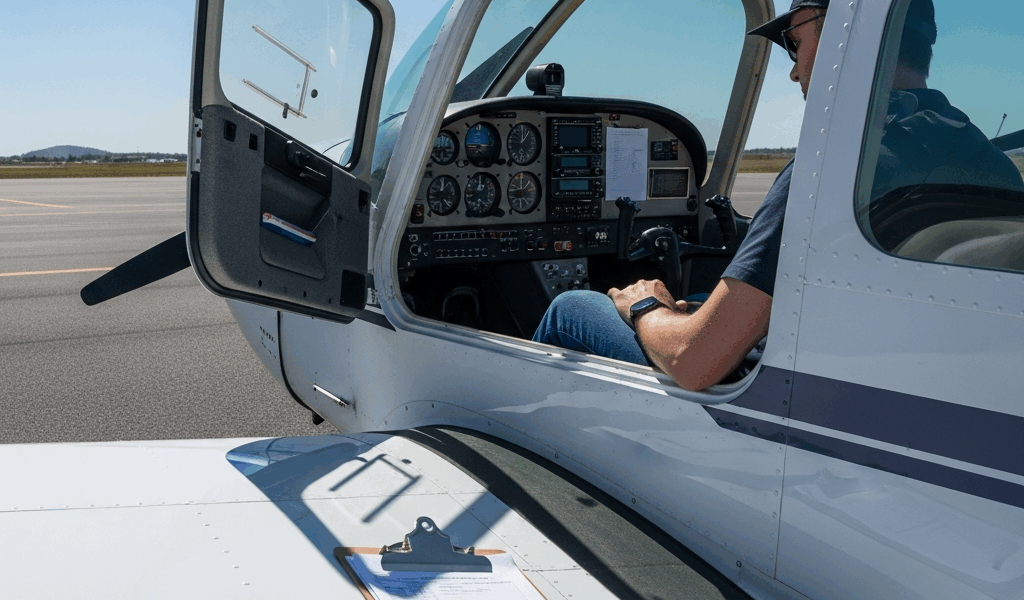
Sport Pilot vs Private Pilot — Which Certificate Makes More Sense for You
The sport pilot vs private pilot debate comes up constantly in my ground school sessions, and I’ll give you the same answer I give every student who asks: get your private pilot certificate. Full stop. There are exceptions — real ones — and I’ll cover them honestly. But if you’re sitting here trying to decide which path to take, private pilot wins in almost every realistic scenario. I’ve been a flight instructor for eleven years, trained somewhere north of 200 students at three different flight schools, and I’ve watched people make this choice from both sides. The regret flows almost entirely in one direction.
The Quick Answer — Private Pilot Is Almost Always Better
Here’s the verdict before we go any further: sport pilot makes financial sense only if you are flying purely for recreation, you will never want a passenger along after dark, you have no interest in flying into major airports, and — most importantly — you have a medical condition that prevents you from holding an FAA medical certificate.
That’s it. That’s the entire list.
Pulled into my office last spring by a student who’d already logged eight hours under sport pilot training, I had to deliver some uncomfortable news: the limitations he hadn’t bothered to read about were going to frustrate him within a year. He wanted to eventually fly his family to beach destinations on long weekends. Sport pilot allows exactly one passenger. He has a wife and two kids. Do the math. He restarted his training under the private pilot curriculum. Those eight hours transferred, thankfully, but the mental reset took longer.
The sport pilot certificate was created in 2004 to lower the barrier to entry for recreational flying. Good intention. The execution left pilots in a box. Private pilot takes more time and costs more money upfront, but it removes nearly every constraint that makes flying genuinely useful and enjoyable as a long-term hobby or profession.
Cost and Time Comparison — Real Numbers
Let’s use 2026 pricing because the numbers from five years ago are genuinely useless now. Fuel costs, maintenance, and instructor rates have all moved substantially.
Sport Pilot Training Costs
The FAA minimum for a sport pilot certificate is 20 flight hours. Nobody finishes in 20 hours. I have seen one student come close — 23 hours — and he was a former Air Force crew chief with thousands of hours of aviation exposure before his first lesson. Real-world averages sit at 30 to 35 hours for most students. Here’s what that looks like in 2026 dollars:
- Dual instruction in a light sport aircraft (LSA) — $175 to $220 per hour, instructor included, at most flight schools
- Solo flight time — $130 to $160 per hour for the aircraft alone
- Ground school — $300 to $600 for a structured course, or roughly $200 in self-study materials
- Written exam fee — $175
- Checkride fee — $700 to $900 depending on your examiner and region
Total realistic cost for sport pilot: $5,000 to $8,500. Training at a school running a Cessna 162 Skycatcher or a Pipistrel Virus SW will land you somewhere in that range if you study hard and fly consistently.
Private Pilot Training Costs
The FAA minimum is 40 hours. Average completion runs 60 to 70 hours nationally, though students who fly three or more times per week often finish closer to 55. In 2026:
- Dual instruction in a Cessna 172 — $250 to $320 per hour, instructor included
- Solo flight time — $160 to $200 per hour wet (fuel included)
- Ground school — $400 to $800 structured, or $250 self-study
- Written exam fee — $175
- Checkride fee — $800 to $1,100
Total realistic cost for private pilot: $12,000 to $18,000. Yes, that’s real. Yes, it’s gone up. A student flying a Piper Archer at a busy flight school in the Southeast told me last fall he spent $16,400 by the time his temporary certificate printed.
The gap is real. I’m not minimizing it. But spend an extra $8,000 once versus living with severe restrictions for the rest of your flying life — that math eventually resolves itself for most pilots.
What Sport Pilots Cannot Do — The Real Limitations
Probably should have opened with this section, honestly. When students see these restrictions laid out plainly, the decision usually gets easier.
No Night Flying
Sport pilots cannot fly after official sunset. Not a minute after. This eliminates evening flights home from weekend trips, summer sunset cruises, and any practical cross-country utility in the winter months when darkness comes early.
No Instrument Rating
A sport pilot certificate cannot be built upon with an instrument rating. Ever. If clouds form en route and you’re a sport pilot, your only legal option is to turn around or land. Private pilots who go on to earn their instrument rating can file IFR and fly through clouds legally. Sport pilots are permanently VFR-only, and not just by skill — by law.
Altitude Restrictions
Sport pilots are capped at 10,000 feet MSL, or 2,000 feet AGL — whichever is higher. Flying in the Rocky Mountain West? Large portions of Colorado, Wyoming, and Utah have terrain that makes 10,000 MSL a real constraint. Denver’s traffic pattern sits at 5,673 feet MSL. The mountains start immediately west of town.
Controlled Airport Restrictions
Sport pilots need special FAA authorization to fly into Class B, C, or D airspace — the controlled airports surrounding most cities. Without that endorsement, you’re limited to Class G and Class E airports. That rules out flying into the regional airports most people actually want to visit.
Aircraft Weight and Passenger Limits
Light sport aircraft max out at 1,320 pounds maximum gross weight for land planes. That means no Cessna 172, no Piper Cherokee, no Beechcraft Bonanza. You’re in a narrow category of small aircraft. And you get exactly one passenger. One. Not two. Not a back seat full of friends.
The Medical Question — Sport Pilot’s Real Advantage
Here’s where I give sport pilot its genuine due. If you have a disqualifying medical condition, sport pilot may be the only path to a pilot certificate. That’s not a small thing.
Sport pilots don’t need an FAA medical certificate at all. A valid U.S. driver’s license serves as your medical qualification, provided you’ve never been denied an FAA medical or had one revoked. Conditions that routinely disqualify pilots from a third-class medical — certain cardiac histories, some forms of diabetes requiring insulin, specific neurological conditions — don’t automatically ground sport pilots.
Before you assume sport pilot is your only option for a medical condition, look at BasicMed. Created in 2017, BasicMed allows pilots to fly private pilot operations (no compensation, passengers allowed, up to six seats) after a one-time visit with any state-licensed physician and completion of an online course through AOPA. The medical standards under BasicMed are more lenient than a traditional third-class certificate. Many pilots who assumed they couldn’t pass an FAA medical exam have flown legally under BasicMed for years.
If your condition is severe enough that BasicMed doesn’t cover it, sport pilot becomes a legitimate and sometimes life-changing option. I trained a retired postal worker in his late 60s who had a cardiac stent procedure in 2019. His cardiologist cleared him to drive, and that driver’s license became his ticket to flight. He now flies a Tecnam P92 out of a small grass strip in rural Virginia. He’s logged 180 hours. He couldn’t care less about night flying or instrument ratings. For him, sport pilot was exactly right.
Know your medical situation before you choose a path. If there’s any doubt, pay the $200 for a consultation with an Aviation Medical Examiner (AME) before you spend a dollar on flight training.
Career Path vs Hobby — The Fork in the Road
This section is short because the answer is simple.
Sport pilot is a dead end for aviation careers. Not a detour. Not a longer route. A dead end.
If there is any possibility — any — that you might someday want to fly commercially, earn an instrument rating, add a multi-engine rating, work as a flight instructor, fly charter, or build hours toward an airline transport pilot certificate, you must train under private pilot from the beginning. Sport pilot certificate holders cannot upgrade their certificate to private pilot by logging more hours in sport aircraft. You would have to start a new training track. The hours don’t fully cross over in terms of privileges.
Trained alongside a student in 2018 who started with sport pilot because he wanted to save money before “figuring out what he really wanted to do.” By 2021 he knew he wanted to instruct. He spent 14 months essentially retraining for his private pilot certificate, then his instrument, then his commercial, then his CFI. The sport pilot certificate cost him time and real money in duplicate training. He doesn’t talk about it much.
Private pilot, on the other hand, is the foundation of everything. You can add:
- Instrument rating — fly in clouds, file IFR, operate in low visibility legally
- Commercial pilot certificate — get paid to fly
- Multi-engine rating — fly twin-engine aircraft
- Certified Flight Instructor certificate — teach others and build hours toward airline minimums
- Airline Transport Pilot certificate — fly for regional and major airlines
None of those doors open from the sport pilot side.
Even as a pure hobbyist with zero interest in a career, private pilot gives you the aircraft variety, the airspace access, the passenger capacity, and the night flying freedom to actually use your certificate. Cross-country trips become practical. Visiting friends in cities with controlled airports becomes routine. Bringing along a spouse, a friend, or two kids becomes possible.
Making the Final Call
I’ve laid out the math, the regulations, and the lived experience. Here’s the summary I’d put in front of any student walking into my office today.
Choose sport pilot if you have a medical condition that prevents BasicMed qualification, you genuinely want to fly alone or with one passenger in good weather during daylight hours only, and you have zero professional aviation ambitions. That combination exists. It’s real. Sport pilot serves that person well.
Choose private pilot if you have any flexibility on the medical question, any interest in flying with more than one passenger, any possibility of night flights, any curiosity about instrument flying, any professional aviation interest whatsoever, or simply want a certificate you won’t outgrow in two years.
The cost difference is real. Roughly $8,000 to $10,000 separates the two paths in 2026 dollars. That’s not nothing. But aviation is an expensive hobby at any level. Spending an extra month saving money before starting private pilot training beats spending that same money on a certificate you’ll want to upgrade eighteen months from now.
Get the private pilot certificate. Train consistently — three flights a week minimum if you can manage it — study the ground material seriously, find an instructor you trust, and finish what you start. Most students who stop mid-training do so because they let too many weeks pass between lessons and lose momentum. Don’t let that happen.
The sky doesn’t care which certificate you hold. But you will, once you’re flying.

Stay in the loop
Get the latest skyhighflighttraining updates delivered to your inbox.