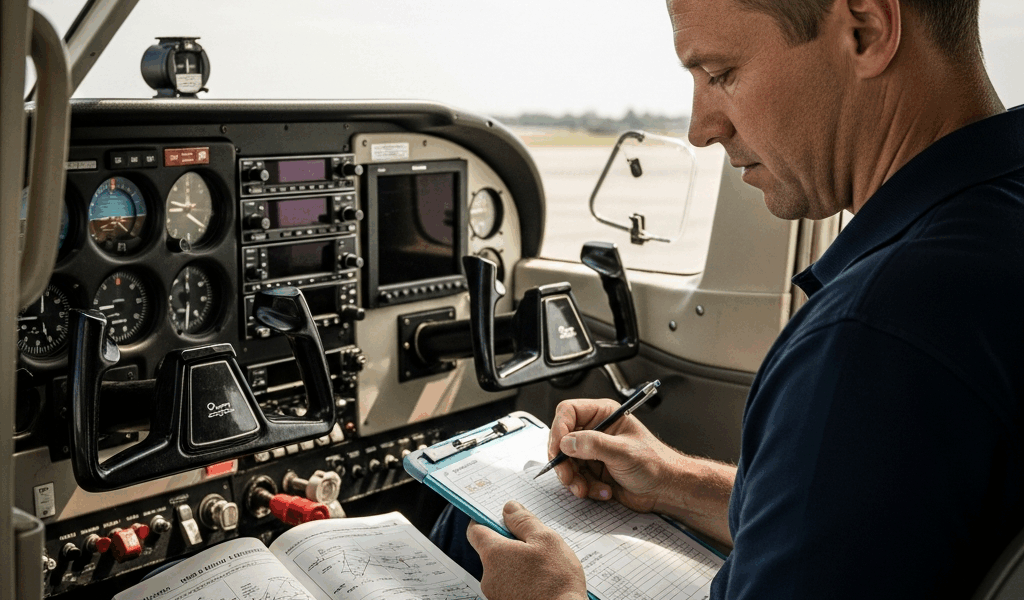
Private Pilot Weight and Balance — Practice Problems with Worked Solutions
Weight and balance practice problems trip up more private pilot students than almost any other knowledge test topic — not because the math is hard, but because nobody walks them through a complete calculation using actual aircraft numbers. I failed my first mock oral exam on this exact subject. My CFI asked me to demonstrate a full weight and balance for our Cessna 172, and I froze halfway through because I’d studied the concept but never done the arithmetic start to finish with real moment arms and a real CG envelope chart in front of me. That was a $180 lesson I only needed once. What follows are fully worked scenarios using Cessna 172-specific numbers, the kind your examiner will actually hand you on checkride day.
Weight and Balance Basics — What the Checkride Actually Tests
The checkride examiner is not testing whether you can recite the definition of center of gravity. They already assume you know what it is. What they’re testing is whether you can execute the calculation correctly under mild pressure and then interpret the result against the aircraft’s CG envelope chart without making a catastrophic error.
There are four specific things every examiner checks:
- Can you locate the correct arm for each station in the Pilot’s Operating Handbook?
- Can you calculate the moment for each item — weight multiplied by arm equals moment, every time, no exceptions?
- Can you sum the total weight and total moment correctly?
- Can you plot the resulting CG location on the envelope chart and declare the aircraft within or out of limits?
The pass/fail line is sharp. If you do the math wrong and declare an out-of-limits aircraft airworthy, that’s an automatic failure. Not a ding. Not a note in the debrief. A failure. The examiner’s job is to make sure you would never put passengers in an unstable airplane because you rushed through arithmetic. Understand every step before you walk into that room.
Probably should have opened with this section, honestly — but the point stands regardless of where it lands: there is no “close enough” on weight and balance.
Cessna 172 Weight and Balance — The Key Numbers
Pulled through dozens of Cessna 172 POHs across model years N, P, R, S, and SP, I settled on a consistent set of reference arms that appear in FAA knowledge test problems and in most training aircraft documents. Use these to practice. Use your specific aircraft’s Weight and Balance Record for the actual checkride.
- Front seats (pilot and right-seat passenger): approximately 37 inches aft of datum
- Rear seats: approximately 73 inches aft of datum
- Baggage area: approximately 95 inches aft of datum
- Fuel (wing tanks, 172S): approximately 48 inches aft of datum
- Oil: approximately negative 14 inches (forward of datum — this subtracts from your total moment)
Standard weights you need memorized: aviation gasoline (100LL) is 6 lbs per gallon. The 172S carries 56 gallons total, 53 gallons usable. Max gross weight on the 172S is 2,550 lbs. Earlier models like the 172N cap at 2,300 lbs. The empty weight and its associated CG arm live in the aircraft’s Weight and Balance Record — not in a generic POH table — and that number changes every time a mechanic adds or removes equipment. Always pull the current document.
Practice Problem 1 — Standard Training Flight
The Scenario
You are flying a Cessna 172S. The aircraft’s Weight and Balance Record shows an empty weight of 1,734 lbs with a CG arm of 40.5 inches. You have the following occupants and load:
- Pilot (front left): 170 lbs
- Passenger (front right): 145 lbs
- Two rear passengers: 155 lbs each
- Baggage: 25 lbs
- Fuel: 38 usable gallons
Step-by-Step Solution
First, convert fuel to pounds: 38 gallons × 6 lbs/gallon = 228 lbs of fuel.
Now build the table — weight times arm equals moment for every station:
- Empty aircraft: 1,734 lbs × 40.5 in = 70,227 in-lbs
- Front seats (combined): 315 lbs × 37 in = 11,655 in-lbs
- Rear seats (combined): 310 lbs × 73 in = 22,630 in-lbs
- Baggage: 25 lbs × 95 in = 2,375 in-lbs
- Fuel: 228 lbs × 48 in = 10,944 in-lbs
Total weight: 1,734 + 315 + 310 + 25 + 228 = 2,612 lbs
Stop right there. The 172S max gross weight is 2,550 lbs. You are 62 lbs over gross before you’ve even touched the CG calculation. The examiner expects you to catch this immediately.
What do you remove? Baggage goes first — 25 lbs. Still over by 37 lbs. Reduce fuel by 7 gallons (42 lbs), bringing fuel to 31 usable gallons and fuel weight to 186 lbs. New total weight: 2,612 − 25 − 42 = 2,545 lbs. Within limits.
Recalculate with the adjusted fuel and no baggage:
- Empty aircraft: 70,227 in-lbs
- Front seats: 11,655 in-lbs
- Rear seats: 22,630 in-lbs
- Baggage: 0
- Fuel: 186 lbs × 48 in = 8,928 in-lbs
Total moment: 70,227 + 11,655 + 22,630 + 8,928 = 113,440 in-lbs
CG location: 113,440 ÷ 2,545 = 44.6 inches aft of datum
Plot 2,545 lbs on the Y axis and 44.6 inches on the X axis of the CG envelope chart. For the 172S, the aft CG limit at that weight is approximately 47.3 inches. Forward limit is approximately 35.0 inches at max gross. At 44.6 inches, this aircraft is within the envelope. Legal to fly.
Practice Problem 2 — Fuel Planning and CG Shift
The Scenario
Same aircraft, same initial loading (post-adjustment from Problem 1 — 2,545 lbs, CG at 44.6 inches, total moment 113,440 in-lbs). You fly for approximately two hours and burn 28 gallons of fuel.
Step-by-Step Solution
Fuel burned: 28 gallons × 6 lbs/gallon = 168 lbs removed from the fuel arm at 48 inches.
Moment removed with that fuel: 168 lbs × 48 in = 8,064 in-lbs
Landing weight: 2,545 − 168 = 2,377 lbs
Landing moment: 113,440 − 8,064 = 105,376 in-lbs
Landing CG: 105,376 ÷ 2,377 = 44.3 inches aft of datum
The CG moved slightly forward. That’s expected — the fuel arm (48 inches) sits aft of the aircraft’s CG, so burning fuel from that location pulls the CG forward. Still within limits at 44.3 inches. Legal to land.
Here’s why this problem matters: some loading configurations that are legal at takeoff drift out of limits as fuel burns. Heavy rear-seat passengers with minimal front-seat occupant weight combined with a full fuel load can produce a legal takeoff CG that slides aft of limits once those wing tanks empty. The math tells you before the airplane does. Always verify both the takeoff and the landing condition when the loading is anything unusual.
Reading the CG Envelope Chart — What Examiners Expect
The CG envelope chart is a two-axis graph. The X axis runs left to right showing CG location in inches aft of datum. The Y axis runs bottom to top showing gross weight in pounds. Your calculated point — weight on Y, CG on X — must land inside the shaded envelope to be airworthy.
Common student mistake: reversing the axes and plotting weight on X, CG on Y. The chart is unreadable that way and the examiner will catch it immediately.
Two separate boundaries define the envelope:
- Forward CG limit: A structural and handling limit. Too far forward means the nose is heavy, elevator authority decreases, and rotation on takeoff requires excessive back pressure. At extreme forward CG, the aircraft may not rotate at all at published Vr.
- Aft CG limit: A stability limit. Too far aft reduces the tail’s ability to provide pitch damping. The aircraft becomes increasingly sensitive to pitch inputs, and recovery from stalls or unusual attitudes requires more altitude and correct technique.
When an examiner asks “what would happen if your CG were aft of limits,” the answer that passes is not “it would be out of limits.” That’s circular. The answer they want: reduced longitudinal stability, increased sensitivity to pitch inputs, degraded stall recovery, and reduced margin for pilot error in upset recovery. Explain the aerodynamics, not just the legal status. That’s the difference between reciting a rule and understanding it — and examiners hear that difference every single checkride.
The numbers in this article give you a working framework. The habit of checking every condition, takeoff through landing, is what actually keeps passengers safe.




Stay in the loop
Get the latest skyhighflighttraining updates delivered to your inbox.