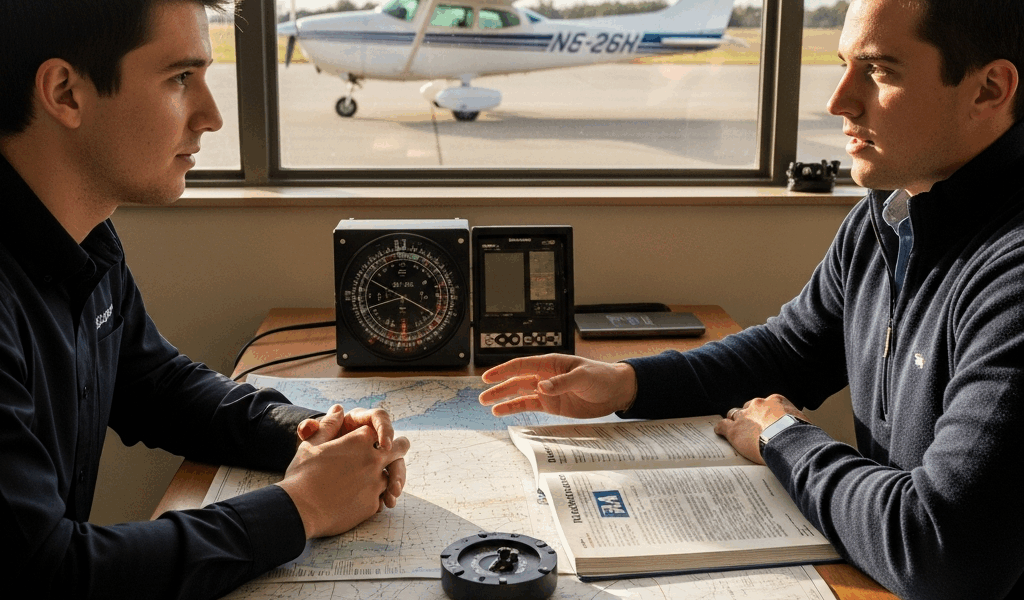
Private Pilot Checkride Oral Exam — Most Common Questions and How to Answer Them
Checkride prep has gotten complicated with all the conflicting advice flying around. Study guides, YouTube videos, Reddit threads — everyone’s got a system. As someone who’s sat in the right seat during dozens of checkrides, I learned everything there is to know about what actually separates a pass from a pink slip. Today, I will share it all with you.
Here’s the short version: pilots who pass understand the why behind their answers. Not just the answers. The examiners I’ve worked with aren’t collecting scalps — they’re checking whether you’re safe to fly solo. Frame every single answer through that lens and the questions that seemed impossible suddenly make sense.
Airspace Questions — What the Examiner Really Wants to Hear
But what is the airspace question really about? In essence, it’s a chart-reading competency check. But it’s much more than that — it’s the examiner asking whether you’re the kind of pilot who looks before flying, or the kind who figures it out mid-flight.
Airspace trips up more students than anything else. Six classes. Blending requirements. You memorize altitudes and equipment lists, then your brain short-circuits when the examiner asks something slightly sideways. So, without further ado, let’s dive in.
Class B first. The big commercial airports — New York, Chicago, Los Angeles. You need a Mode C transponder, a working altimeter, and two-way radio communication on the correct frequency. That’s the actual legal requirement, not a mnemonic. Class B also requires explicit ATC clearance before entry. Not just a call. An actual clearance with your tail number acknowledged. Students miss that last part constantly.
Class C surrounds medium-sized hubs. Mode C transponder plus two-way comms. Here’s where students freeze — they mix up Mode A and Mode C. Mode C is required if you have it, but an older Mode A transponder is technically still legal in Class C. Now, the Mode C veil. This is probably where I see the most mistakes. That veil extends 30 nautical miles from certain Class B airports, down from 10,000 feet MSL. You need Mode C inside that veil even if you’re nowhere near actual Class B airspace. I watched a student bust a checkride once because he’d planned a cross-country that clipped the Mode C veil around DFW without the right equipment. Cost him $800 and another three weeks of waiting. Don’t make my mistake — well, his mistake, but I’ve repeated it to every student since.
Class D wraps around smaller towered airports. Two-way comms. That’s it — no transponder requirement. But here’s where pilots get sloppy: you have to establish that communication before crossing the boundary. Not at the boundary. Before. Tower has to acknowledge your call sign specifically. An unnamed “traffic in the area” call doesn’t count.
Class E is where most training happens. Below 10,000 feet — 3 statute miles visibility, 500 feet below clouds, 1,000 above, 2,000 horizontal. Above 10,000 feet it jumps to 5 miles and 1,000 foot vertical separation. No radio required. No transponder. That’s why your Cessna 150 cross-country to the little grass strip 40 miles away doesn’t require a single radio call.
Class G — the uncontrolled remainder. Below 1,200 feet AGL during daytime VFR, you need 1 statute mile visibility and remain clear of clouds. At night that becomes 3 miles visibility. Memorize those numbers. The examiner will ask.
That’s what makes airspace endearing to us student pilots — once you understand the structure, the requirements actually make logical sense based on how busy each environment is.
Weather and Go/No-Go Decision Making
This section separates pilots who think from pilots who memorize. You’ll get a METAR. Maybe a TAF. Possibly an entire weather package dropped in front of you with the question: “Would you go?”
A real METAR looks like this: KJFK 121851Z 24016G28KT 3SM -SN BKN014 OVC025 M04/M17 A3034. Let me walk through it. KJFK is the identifier. 121851Z — 12th day, 1851 UTC. 24016G28KT is wind from 240 degrees at 16 knots, gusting to 28. That gust matters for your performance numbers and your crosswind component calculation. 3SM is 3 statute miles visibility. The -SN is light snow. BKN014 OVC025 — broken layer at 1,400 feet, overcast at 2,500 feet. M04/M17 is temperature and dew point, both below freezing. Icing country. A3034 is your altimeter setting.
What the examiner doesn’t want is a robotic recitation. They want interpretation. Something like: “Wind at 16 gusting 28 from 240 — that’s approaching my personal crosswind limit of 15 knots steady. Visibility at 3 miles in snow is right at legal minimums, which is below my personal floor of 5 miles in precipitation. Temperature minus 4 with icing conditions in those cloud layers. I’m not departing.” Specific. Decisive. Yours.
Probably should have opened with this section, honestly — because the legal minimums versus personal minimums distinction is the single thing examiners probe hardest. Legal VFR minimums are the floor, not the standard. Your personal minimums are higher. Smart pilots write them down. “I don’t fly with ceilings below 2,000 feet. I don’t fly in crosswinds above 12 knots. I don’t depart if my destination forecast is below 3 miles visibility with no usable alternate.” Vague answers like “I’d make sure it was safe” don’t cut it. The examiner wants numbers.
The go/no-go question is really a PIC question. You’re not hiding behind an instructor anymore. You make the call. If you say you’d depart, be ready for the follow-up: “What if conditions deteriorate en route?” You’d better have an alternate picked out — and it’d better not be socked in too.
Aircraft Systems — Know Your Airplane
Frustrated by a student’s generic answers one morning, an examiner I know stopped mid-oral and slid the POH across the table. “Tell me how this airplane works.” The student couldn’t do it. He’d memorized a generic Cessna description from a study guide and never actually read his specific POH. That was the end of that checkride.
I’m apparently a Cessna 172 person — the 172S specifically — and the Skyhawk works for me while the older carbureted 172N never quite clicked the same way. Different systems. Different procedures. Know which one you’re flying.
The 172 runs a 60-amp alternator, not a generator. There’s a main electrical bus and an essential bus. Alternator fails — you still have battery. Maybe 30 minutes if you start shedding load immediately: autopilot off, interior lights off, non-essential avionics dark. You’re buying time to land, not to troubleshoot.
Vacuum system failure catches students because they assume the instruments spin down slowly. They don’t. Your attitude indicator and heading indicator both go unreliable fast — think lazy Susan on a frictionless bearing. You’re left with airspeed, altimeter, turn coordinator, and VSI. The turn coordinator runs on electrical power, not vacuum. That matters. Partial panel flying gets its own demonstration during the flight portion, but the oral will ask you to explain the failure and your response.
Carburetor icing — and this is where students consistently get it wrong. They picture ice forming only in cold weather. But carburetor icing can happen at 70°F on a muggy August afternoon. Air expands through the carburetor venturi, temperature drops, moisture in the air hits dew point inside the throat, and you get ice blocking fuel flow. The fix is pulling carb heat. Warm, unfiltered air routes around the carb, raises the temperature above freezing. You’ll likely see a slight RPM drop first — that’s actually a good sign. It means the ice is melting and passing through the engine.
Fuel starvation versus fuel exhaustion. Different problems. Starvation means fuel exists in the tanks but can’t reach the engine — wrong fuel selector position, usually. Exhaustion means it’s genuinely gone. On the 172, you’ve got left and right tanks. Switch roughly every 30 minutes in cruise. It’s in the checklist for weight and balance reasons, not just fuel management.
Emergency Procedures That Trip Up Students
Engine failure on takeoff. Here’s the thing — below 1,000 feet AGL with no usable field ahead, the answer is not “turn back to the airport.” The impossible turn kills people. You don’t have the altitude. Physics doesn’t care how good a pilot you are. You land straight ahead, in whatever is straight ahead. Field, road, open ground — straight ahead. That’s the answer. I’ve heard students say “I’d turn back” more times than I can count, and every examiner in the country will probe that answer until it falls apart, because it will fall apart.
Above 1,500 feet and lined up well with a long runway — different conversation. But “certain I can make it back” is a dangerous phrase. Most engine-failure fatalities in the pattern involve pilots who were almost certain.
Electrical fire in flight. Students overthink this. Smell smoke or see it: master switch off. Starve the fire of power. Then land. Immediately. Not at your destination — somewhere. You don’t diagnose, you don’t toggle switches hunting for the bad circuit. You kill it and get on the ground. That’s the whole procedure.
Partial panel. The examiner will cover your attitude indicator and heading indicator during the flight portion, then ask you in the oral to describe your scan. Turn coordinator becomes primary bank reference. Altimeter becomes primary pitch reference, confirmed with VSI trend. Airspeed backs up both. You’ll overcontrol — everyone does. The trick is trusting instruments you don’t usually lead with and making small inputs. Smooth is better than fast here.
Regulations and Privileges You Must Know Cold
Currency requirements are specific. Three takeoffs and landings in the past 90 days to carry passengers — and they need to be to a full stop. Touch-and-goes don’t count for currency purposes. I’m apparently one of the few instructors who drills this distinction hard from day one, and students who fly with me tend to nail this question cold while others stumble.
Night currency runs on the same 90-day clock, but requires three full-stop night landings specifically. Night is defined as one hour after sunset to one hour before sunrise. Lapsed on your night landings? You can still fly at night — you just can’t carry passengers until you’re current again. Different rule, same timeframe. Don’t mix them up.
Medical certificates: Class 1 for airline transport, Class 2 for commercial, Class 3 for private and recreational. As a private pilot you need at least a Class 3. BasicMed is the newer alternative — you can fly without a traditional FAA medical if you’ve held a medical certificate at any point and you complete the online course every 24 months. But here’s the catch: if you’ve never held any FAA medical certificate, BasicMed isn’t available to you. You need the real thing first.
High performance endorsement — required for any airplane with more than 200 horsepower. Complex endorsement covers retractable gear, constant-speed prop, or both. Your CFI signs off in your logbook. No separate rating, no additional test — just a logbook entry. But without it, you can’t legally fly those airplanes. This trips up pilots who upgrade to a faster airplane without checking.
Passenger carrying privileges are pretty clean once you’re certificated: valid medical, current flight experience, and you can take passengers as long as no one’s paying you — except for legitimate cost-sharing, where splitting fuel, oil, and landing fees is allowed.
One last thing. Regulations change. The FAA updates Part 61 and Part 91 regularly, and study guides go stale fast. That BasicMed rule didn’t exist before 2017. Some training materials still don’t cover it properly. Check the current FARs before your checkride — not your buddy’s notes from 2019, not a used Gleim book. The current regulations. This new rule took off several years after the old medical structure and eventually evolved into the BasicMed framework pilots know and use today. Know it cold before you walk in.
The oral exam is testing one thing: whether you think like a safe pilot. Study the reasoning, not just the answers. Practice explaining out loud — to your dog, your mirror, whoever. The examiner will hear the difference between memorized words and actual understanding. And so will you.


Stay in the loop
Get the latest skyhighflighttraining updates delivered to your inbox.