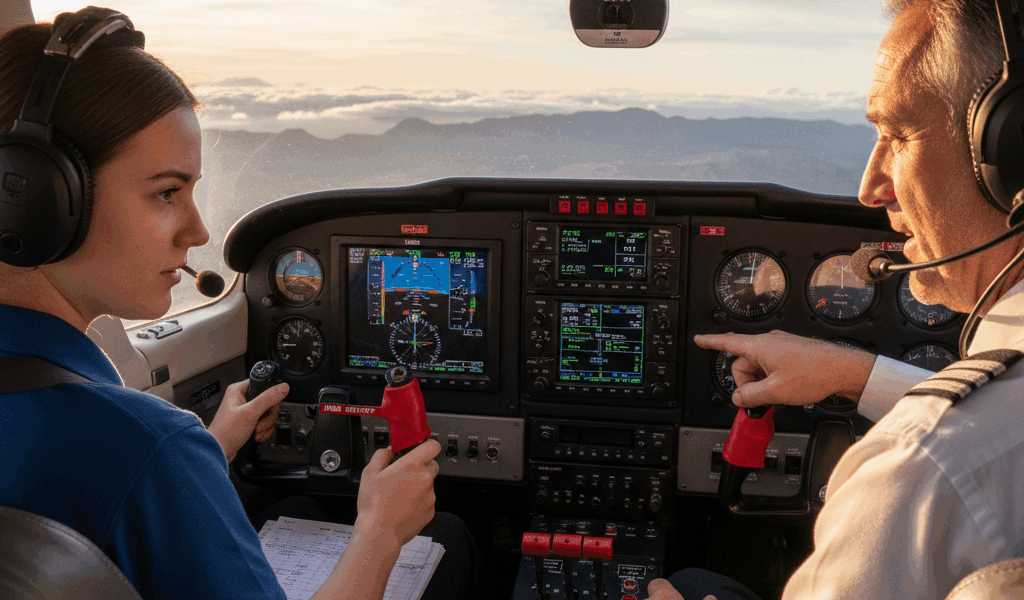
As someone who has spent over a decade in the right seat of training aircraft, I learned everything I know about emergencies the hard way – through practice, practice, and more practice. Probably should have led with this: engine failure after takeoff is the scenario that keeps me up at night as an instructor.
We devoted today’s entire session to emergency procedures. My student and I focused specifically on the situations most likely to test decision-making when the adrenaline is pumping and time is short.
Engine Failure After Takeoff
This is the big one. You have maybe five seconds to react, minimal altitude to work with, and no good options – just less-bad ones. The textbook says pitch for best glide, pick a landing spot ahead, and whatever you do, resist the urge to turn back to the runway.
We practiced from 400 feet AGL, roughly where you would be at the end of a typical climb segment. I pulled the throttle to idle, pitched immediately for 65 knots, and started scanning for landing options. Fortunately our training area has several open fields that would work in a pinch. Not ideal, but survivable.
The Impossible Turn – And Why It Earns That Name
We talked at length about why turning back to the runway usually ends badly. The math is brutal: you need altitude to complete the turn, and most training aircraft simply cannot pull off a 180 and realign with the runway from less than 800-1000 feet AGL. Attempting it at 400 feet? That has gotten complicated with all the physics working against you – there is a reason pilots call it the impossible turn.
I had my student practice the maneuver from a safe altitude anyway, just to understand the energy requirements involved. She was genuinely surprised how much altitude we shed even with proper technique. That lesson stuck – I could see it click.
The Other Scenarios Worth Practicing
We also worked through partial power loss, electrical failures, and simulated instrument failures. Each scenario has its own decision tree, but the common thread never changes: aviate, navigate, communicate. Keep the airplane flying first, figure out where you are going second, tell someone what is happening third.
Emergency training is never fun. But it might save your life someday. That is what makes this kind of practice absolutely essential for every pilot.

Stay in the loop
Get the latest wildlife research and conservation news delivered to your inbox.