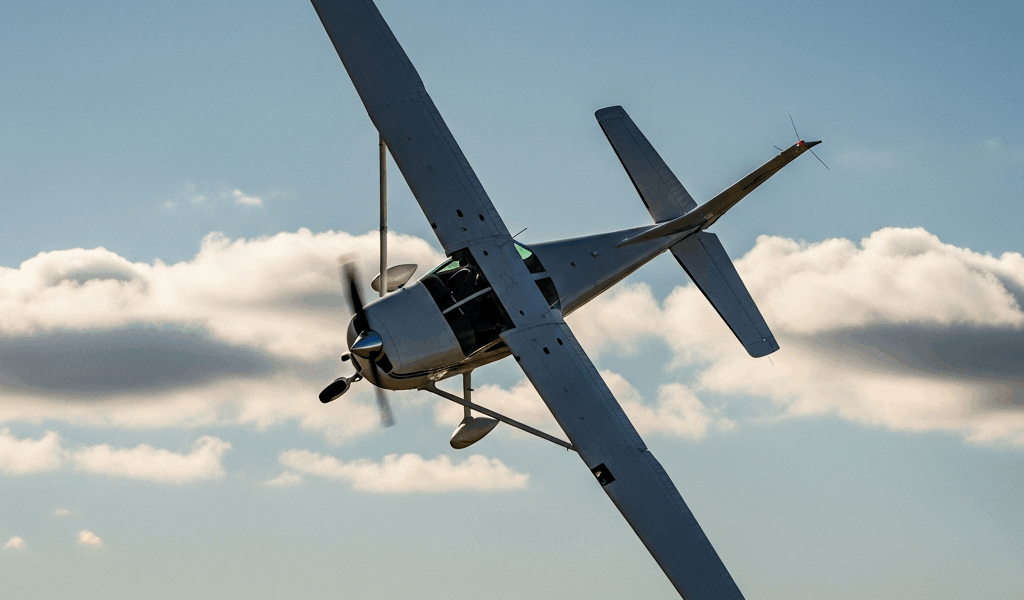
Cessna 172 Spin Recovery — What Every Student Pilot Needs to Know
Cessna 172 spin recovery is one of those topics that flight training glosses over just enough to make you think you understand it — and not quite enough to make sure you actually do. I’ve been flying and instructing for over a decade, and the number of private pilot candidates I’ve met who can recite the PARE acronym but have never felt a spin, never recognized one in progress, and never actually pulled off a recovery — it’s unsettling. This article is the briefing I give students before we talk about stalls, before we talk about slow flight, and honestly, before we talk about much else. Because everything else builds on this.
Can a Cessna 172 Actually Spin
Probably should have opened with this section, honestly. Students ask me all the time: “Is the 172 even spinnable?” The answer matters a lot, so let’s be direct.
Yes. The Cessna 172 can spin. Whether yours is certified for intentional spins depends entirely on which category it’s operating in at the time you try it.
The 172 is certified in two weight categories. In Normal category, maximum gross weight is 2,550 lbs, and intentional spins are prohibited. In Utility category, the aircraft operates at a lower gross weight — typically 2,200 lbs or below depending on the specific aircraft and POH — and intentional spins are approved. Your POH will have the exact numbers. Look up your specific serial number if you’re not sure; there are variations across model years from the 172A through the 172S.
Check the placard in your airplane. Most 172s you’ll train in have something like: “INTENTIONAL SPINS PROHIBITED EXCEPT IN UTILITY CATEGORY.” That placard is not decoration. It reflects real aerodynamic and structural certification testing.
Here’s the practical implication. If you want to do intentional spin training in a 172 — and I’ll argue later that you should — you need to be within Utility category limits. That means checking weight and CG before the flight, not just for legal compliance, but because CG position actually affects how the airplane spins and whether recovery is straightforward or stubborn. Aft CG makes the 172 more spin-prone and harder to recover. That’s physics, not opinion.
The Normal category restriction exists partly because the 172’s aft CG envelope in Normal operations gets close to limits where spin recovery becomes significantly less predictable. It resists entering a spin when properly loaded in Normal category — but “resists” is not the same as “won’t.”
How Spins Actually Happen in a 172
Almost no one enters a spin on purpose. That’s the honest truth behind why spin awareness matters more than most students realize during training.
A spin requires two things to happen simultaneously: a stall and a yaw. Stall alone gives you a stall. Yaw alone gives you a coordinated turn or a skid. Put them together — specifically uncoordinated flight while stalled — and you have a spin entry. The 172 will tell you what’s coming if you’re paying attention. Most pilots who die in spins weren’t paying attention, or they were distracted by something else entirely.
The classic scenario — and I mean classic in the worst sense — is the base-to-final turn. You’re in the pattern. You’ve descended a little too far, you’re overshooting final, and you’re slow because you’ve got some flaps down and you’re trying to be stabilized. You add inside rudder to tighten the turn. Maybe you add a little back pressure because the nose is dropping. You’re now slow, with the ball out of center, and you’re pulling the nose up with elevator.
The outside wing — the high wing — is moving faster through the air. The inside wing is moving slower. If you’re near stall speed, that inside wing stalls first. The airplane rolls and yaws toward the stalled wing. The nose drops sharply and the world starts rotating. You’re at 800 feet AGL. You have almost no altitude.
That scenario kills pilots. It has killed pilots with hundreds of hours. It kills pilots who “knew” about spins the same way you might “know” about a car accident — abstractly, theoretically, from a distance. The only cure is real understanding and real training.
Other common setups include distracted slow flight during a go-around, fumbling with avionics while maneuvering, and steep turns at low altitude flown with sloppy rudder coordination. Any time you’re slow and uncoordinated, the door is open.
What a Spin Feels Like — So You Recognize It
Trained by my own CFI in a Cessna 172N at a small airport in the Midwest, I did my first intentional spin at about 4,500 feet AGL on a cold November morning, and nothing about the book description prepared me for the physical sensation. I expected something dramatic. What I got was fast and disorienting in a quiet, specific way that I want to try to describe accurately.
The entry feels like a normal stall buffet — and then something different happens. There’s a sharp yaw. The nose drops hard, not slowly, and one wingtip swings toward the ground in a way that doesn’t match anything you’ve done in the airplane before. The horizon disappears from your windscreen and is replaced by rotating terrain. The altimeter unwinds. The airspeed is low — stuck near or below stall speed. The ball is pegged to one side.
The disorientation is real. I won’t pretend otherwise. In those first few seconds, your brain is trying to make sense of what it’s seeing while your vestibular system is sending completely different signals. This is why recognition comes before everything else. You cannot recover from something you haven’t identified yet.
Here’s what to look for. In an incipient spin — the first one or two rotations — you’ll see:
- Nose pointed well below the horizon, often 45 to 90 degrees down
- Consistent rotation in one direction — the airplane keeps turning the same way
- Low airspeed despite the nose-down attitude
- High descent rate — the 172 loses roughly 500 feet per developed spin rotation
- Rudder input feels ineffective if you try to use it the wrong way
Don’t confuse a spin with a spiral dive. In a spiral, airspeed is increasing rapidly and the airplane is pulling significant G. In a spin, airspeed stays low. The recovery is completely different. This distinction has killed pilots who pulled back on the stick during a spiral — overstressing the airframe at high speed — because they thought they were in a spin. Know the difference.
The PARE Method — Step by Step
PARE. Power idle. Ailerons neutral. Rudder opposite. Elevator forward. Four steps. In that order. Every time.
Let me walk through each one and explain what it’s doing to the airplane — and what happens when pilots skip a step or do them out of sequence.
Power — Idle
Throttle to idle immediately. Power adds torque and slipstream effects that can accelerate rotation or complicate recovery. In a 172 with the Lycoming O-320 or O-360, that engine torque is real. Get it out of the equation first. Some pilots instinctively want to add power to “climb out” — resist that completely.
Ailerons — Neutral
This one surprises students. Your first instinct is to use aileron to level the wings. Don’t. In a spin, aileron input in the direction of recovery can actually steepen the rotation — the down aileron on the rising wing increases drag on that wing and worsens the asymmetry. Aileron into the spin can prevent recovery entirely in some aircraft. Put the ailerons at neutral and leave them there until the spin has stopped.
Rudder — Full Opposite
Identify the direction of rotation. Apply full rudder in the opposite direction — promptly and completely. This is the step that actually stops the rotation. The rudder is the primary anti-spin control. “Full” means full. Not partial. Your foot goes to the floor. Hold it there until rotation stops.
Elevator — Forward
After opposite rudder is applied, briskly move the elevator forward — in a 172 that means forward yoke pressure, enough to break the stall on the inner wing. This is what unstalls the airplane. Without it, you have opposite rudder but you’re still stalled, and the airplane may not recover cleanly. Forward doesn’t mean a violent push — it means deliberate, firm forward pressure.
Once rotation stops, neutralize the rudder. Then recover from the resulting dive with smooth back pressure. This is where pilots make a second mistake: pulling back too aggressively and either re-stalling or overstressing the airframe. Smooth pull, wings level, power as needed.
I once watched a student apply opposite rudder and then wait for something to happen without moving the elevator. We went through three rotations before I took the controls. That extra altitude cost us about 1,500 feet. It reinforced for me that the sequence matters and that hesitation is its own kind of error.
Spin Awareness vs Spin Training — What the FAA Requires
The FAA’s requirements here are genuinely confusing to most students, so let’s be precise.
For a Private Pilot Certificate, 14 CFR 61.107 requires training in “spin entry, spins, and spin recovery procedures” — but only to the level of awareness. The aeronautical knowledge standard says you need to understand the aerodynamics and recognize scenarios. The practical test standards (ACS) require you to recognize and recover from an incipient spin, which is sometimes demonstrated as an approach to a spin with recovery at the first sign of rotation — not a fully developed spin.
For a Flight Instructor Certificate (CFI), 14 CFR 61.183 requires a logbook endorsement from an authorized instructor confirming actual spin training — entry, full spins, and recovery. CFI candidates have to do the real thing. There’s no awareness exemption.
Here’s my honest take. The private pilot awareness requirement is a minimum. It’s set where it is for practical reasons — access to spin-approved aircraft, student readiness, time constraints. But awareness training done from a book and a video does not prepare you for the actual sensation, the disorientation, or the muscle memory of applying full opposite rudder while the ground is rotating in your windscreen.
If you’re a student pilot or a recently certificated private pilot, find a CFI who will do intentional spin training with you. Ask specifically. Many instructors will say yes if you ask directly. Look for CFIs who advertise aerobatic or upset recovery training — they’re typically comfortable with spins and have spin-approved aircraft available. Expect to pay somewhere in the range of $150–$250 for a one-hour spin training session in a suitable aircraft, which might be a 172 in Utility category, a Citabria 7ECA, or a Super Decathlon. Worth every dollar.
Before you go, brief the PARE steps on the ground until you can say them without thinking. Walk through the physical motions in the cockpit with the engine off. The first time you experience actual spin entry should not also be the first time you’re trying to remember what the letters stand for.
Spin training isn’t about becoming an aerobatic pilot. It’s about removing one of the most survivable accident scenarios from your list of things that could kill you. The 172 is an honest, forgiving airplane. It will tell you what’s coming. The question is whether you’ve prepared yourself to listen — and respond.

Stay in the loop
Get the latest skyhighflighttraining updates delivered to your inbox.