IFR Partial Panel Flying — How to Stay Alive Without Your Attitude Indicator
Partial panel flying has become tricky with all the glass cockpit noise flying around. As someone who has spent twelve years teaching instrument pilots, I spent real time learning the ins and outs of what happens when the panel starts dying on you. Today, I will share it all with you.
The skill itself hasn’t changed. Your scan has. Your priorities shift hard. Instruments you trusted completely become useless plastic and wire, and suddenly you’re navigating by numbers, by feel, by patience you didn’t know you had.
This isn’t your grandfather’s partial panel syllabus from 1974.
What Actually Fails and Why It Matters
But what is a vacuum system failure, really? In essence, it’s the death of your primary attitude reference. But it’s much more than that — it’s a cascade most pilots don’t see coming.
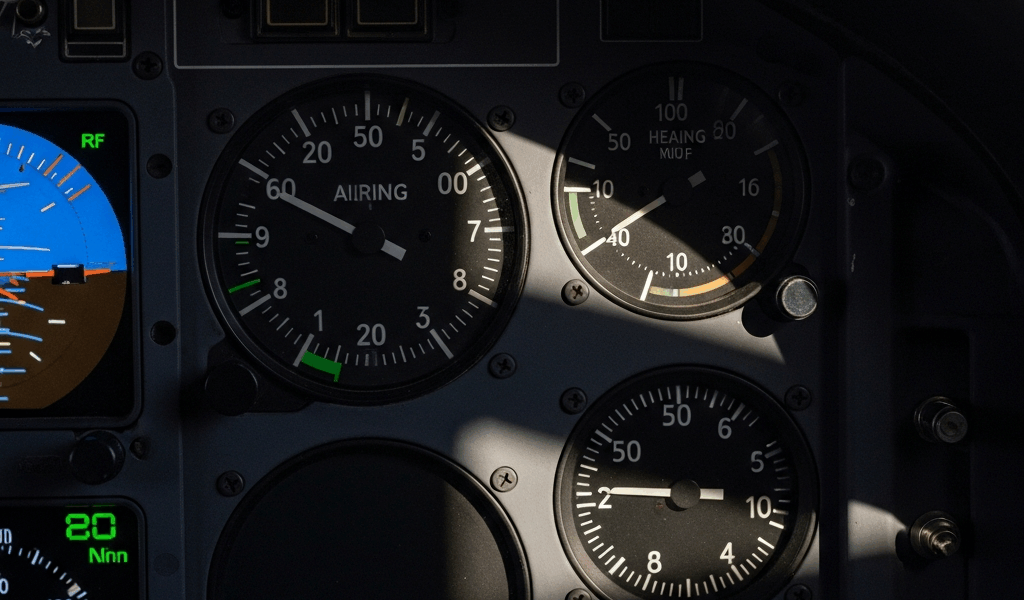
In a conventional steam gauge six-pack, your attitude indicator runs off vacuum pressure. Usually 4.5 to 5.5 inches of mercury, generated by an engine-driven pump. When that pump quits, your AI tumbles. The panel doesn’t go dark. But your primary reference instrument just became dead weight bolted to the panel.
Here’s where most training fails you: it assumes you lose only the AI. Reality is messier. Lose the vacuum pump, and you lose:
- Attitude indicator (AI)
- Heading indicator (HI)
- Vertical speed indicator (VSI)
Your altimeter, airspeed indicator, and turn coordinator still work. They run on electricity or mechanical principles that don’t particularly care about your vacuum system.
Glass cockpit failures look completely different. The Garmin G1000 — which dominates modern certified aircraft — pulls instrument data from multiple sources simultaneously. When the AHRS fails — that’s the Attitude and Heading Reference System — the PFD drops into reversionary mode. Your MFD might still work. Your autopilot dies. Your integrated flight plan might still display, but pitch and bank information simply vanishes.
Quick callout up front. I watched a perfectly capable pilot freeze during a gyro failure in a Cirrus SR22 with G1000 avionics — not because the failure was unsurvivable, but because the panel looked nothing like the training scenario he’d memorized. Understanding failure modes changes everything about your response.
The core difference: steam gauge failures are usually complete losses of an entire system. Glass panel failures are often partial degradations with leftover functionality. That distinction matters enormously at 2,000 feet in actual IMC.
Scan Technique Without the AI
Flying partial panel on steam gauges means flying by numbers and trends — not by the picture your brain evolved to process.
Your new primary instrument is the altimeter. Not the VSI. The actual altitude. You’re hunting for trends in altitude change to infer pitch attitude. Most pilots instinctively grab vertical speed as their primary pitch reference. Don’t. VSI has lag. It tells you what you did thirty seconds ago, not what’s happening right now.
Here’s the scan without the AI:
- Altimeter — needle position and rate of movement
- Airspeed — your angle of attack proxy
- Turn coordinator — bank and turn rate
- Heading indicator — direction, if it hasn’t tumbled
- VSI — confirmation of pitch trend only
The turn coordinator becomes your bank reference. Not supplementary anymore — primary. A standard-rate turn is 3 degrees per second. The needle has markings. You can time turns with nothing but a clock and that needle. That’s enough.
Pitch control is where it gets hard. Watch the airspeed. Maintaining altitude while airspeed climbs? You’re nose-down. Altitude dropping with constant airspeed? Also nose-down. Fix it with small elevator inputs — one-quarter inch at the yoke, then wait. Watch the altimeter. Is it stabilizing? Check the VSI lag response. Give it thirty seconds. You’ll see it.
I practiced this for hours in a Redbird FMX sim before I ever attempted it in real air. The first actual partial panel approach I flew was in a Piper Archer — failed vacuum pump, solid IMC, hands steady but scan wandering. My eyes kept drifting to the useless AI. Muscle memory is a tyrant. I forced myself back to the altimeter every single time. Back to the numbers. Side-step the error I made.
Keep descent rates under 300 feet per minute during approaches. That means tiny pitch inputs. Your instinct screams for aggressive corrections — especially when you’re sinking faster than planned. Resist that instinct. Partial panel flying rewards patience above almost everything else.
Glass Panel Partial Panel — A Different Problem
Reversionary mode in a G1000 gives you a simplified PFD showing altitude, airspeed, and heading. The display is cramped. The information is there — but it looks alien after a hundred hours on a normal PFD.
Here’s what disappears: synthetic vision, terrain awareness, the smooth autopilot integration you’ve come to depend on. Here’s what stays: raw instrument data. That’s actually enough — if you’ve trained for it.
When the primary AHRS fails, the G1000 pulls from a backup source. That backup is often less precise. Heading might drift. Pitch and bank might carry higher error margins. Most G1000-equipped aircraft also include a standby vacuum-powered AI for exactly this scenario — but newer aircraft sometimes skip it because the redundancy feels unnecessary on paper. It isn’t.
I’m apparently a right-screen pilot, and the MFD works for me in reversionary mode while the PFD never quite settles my nerves the same way. I’ve seen pilots completely ignore that MFD in a panic — then suddenly remember it still shows the approach chart, still shows heading. Not ideal. Still information. Use it.
The transition from normal to reversionary is jarring every single time. The font changes. The color scheme shifts from the comfortable blue-and-brown you’ve trusted for two hundred hours to something sparse and monochromatic. That’s what makes G1000 simulator training endearing to us glass cockpit pilots — it’s the only place to experience that transition without consequences. Garmin offers G1000 sims with reversionary mode scenarios built in. Most Part-141 schools can schedule time. A single hour runs under $200. That’s a cheap insurance policy.
Your scan in reversionary mode mirrors partial panel steam gauge technique almost exactly — except you’re reading a digital display instead of analog needles. That should feel easier. It usually doesn’t. Our brains are weird like that.
The Approach — Partial Panel ILS vs. GPS
This is where partial panel flying becomes genuinely consequential. So, without further ado, let’s dive in.
GPS approaches are structurally easier partial panel. Lateral guidance comes from satellites — your heading reference becomes almost secondary. The approach chart shows you the track. The GPS shows you deviation. You can fly an LPV approach missing your attitude indicator entirely because lateral and vertical guidance runs independent of attitude presentation. That’s what makes GPS approaches endearing to us partial panel pilots during emergencies.
I’d never recommend a GPS approach as your first partial panel experience, but cognitively it’s less demanding than an ILS — where you’re cross-checking localizer and glideslope simultaneously while managing pitch by altimeter alone.
ILS partial panel is the real test. You’re flying a heading. Hunting the localizer needle. Managing a vertical descent using VSI and altimeter while the glideslope needle tells you whether you’re on profile. Multiple cognitive tasks. Degraded instruments. No AI. First, you should declare a partial panel emergency — at least if you’re in actual IMC and below 5,000 feet. Tell ATC immediately. You’ll get vectors. You’ll get space. Controllers will hand you to someone who has time for you, slow you down, probably vector you straight-in instead of making you fly the procedure turn.
On approach, shoot for 300 feet per minute descent. Plan generously on time. Rushing is what kills pilots flying partial panel — not the missing instruments.
Practice Scenarios for Instrument Currency
You can’t learn this from reading an article. You need repetition under controlled stress.
Start in the simulator. While you won’t need a full motion Level D device, you will need a handful of quality sim hours in a Redbird, Frasca, or G1000 trainer — any of which can disable the attitude indicator on command. Fly approaches with the failed instruments covered by foggles. Forty minutes of sim time builds scan discipline faster than five real approaches. The turbulence isn’t real. The cross-check discipline absolutely is.
Real-world practice requires a CFI current on partial panel technique. Not all instructors are — ask before you book. Your CFI should be comfortable flying partial panel themselves, not just comfortable explaining it. Ask them to demonstrate the scan first. Watch their eyes. Watch their hand positions. Technique transfers faster by imitation than by description.
A good partial panel session starts with the failure induced on the ground. Engine running, full panel, then the instructor covers your AI and asks you to climb to 1,500 feet. That 60-second exercise teaches panic management faster than any briefing. Brutal. Useful. Do it first.
Then fly straight and level. Then slow flight. Then steep turns. Then an approach with a 1,000-foot ceiling. Only after all of that are you genuinely ready for an unexpected failure scenario — which is, of course, the only kind that actually happens.
Your IFR currency expires every six calendar months. Shoot for one partial panel approach every two months of actual flying. Make it a normal part of currency work. Your insurance company might even discount your premium for it — several underwriters do for pilots who document additional training.
You might go your entire flying career without a real vacuum failure or AHRS fault. You might also hit one at 1,800 feet in solid IMC on a Tuesday night in November. Partial panel flying is the skill separating professional-grade instrument pilots from occasional IFR flyers. Train it like it matters. Because it does.


Stay in the loop
Get the latest skyhighflighttraining updates delivered to your inbox.