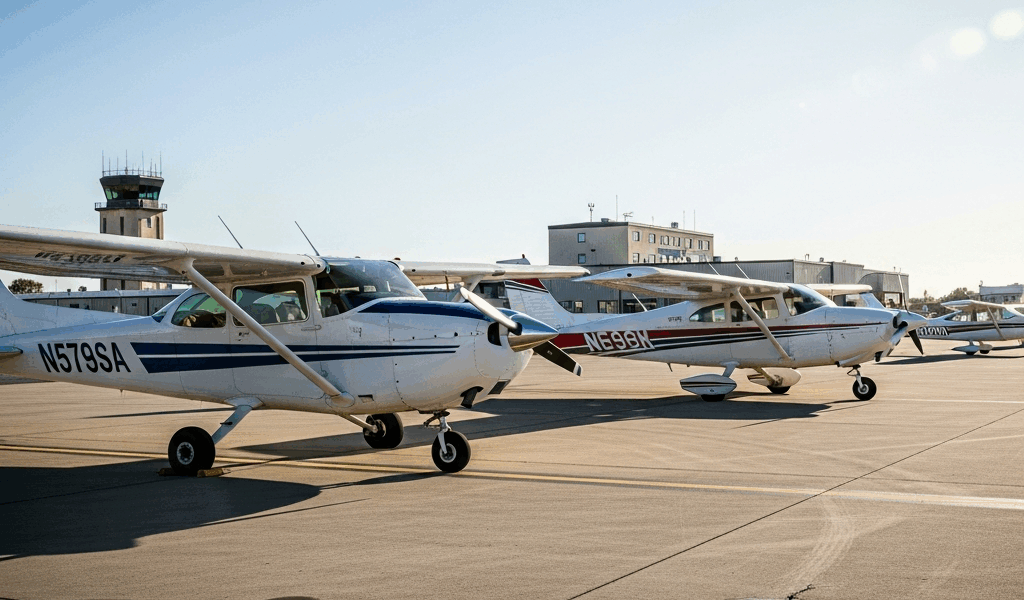
Your flight school has both Cessna 172s and Piper Warriors on the line, and your CFI just asked which one you want to train in. Both airplanes have produced more private pilots than any other trainer in history, and both will get you to your checkride. But they fly differently, cost differently, and prepare you for different things. Here is what actually matters when choosing between them.
The Aircraft at a Glance
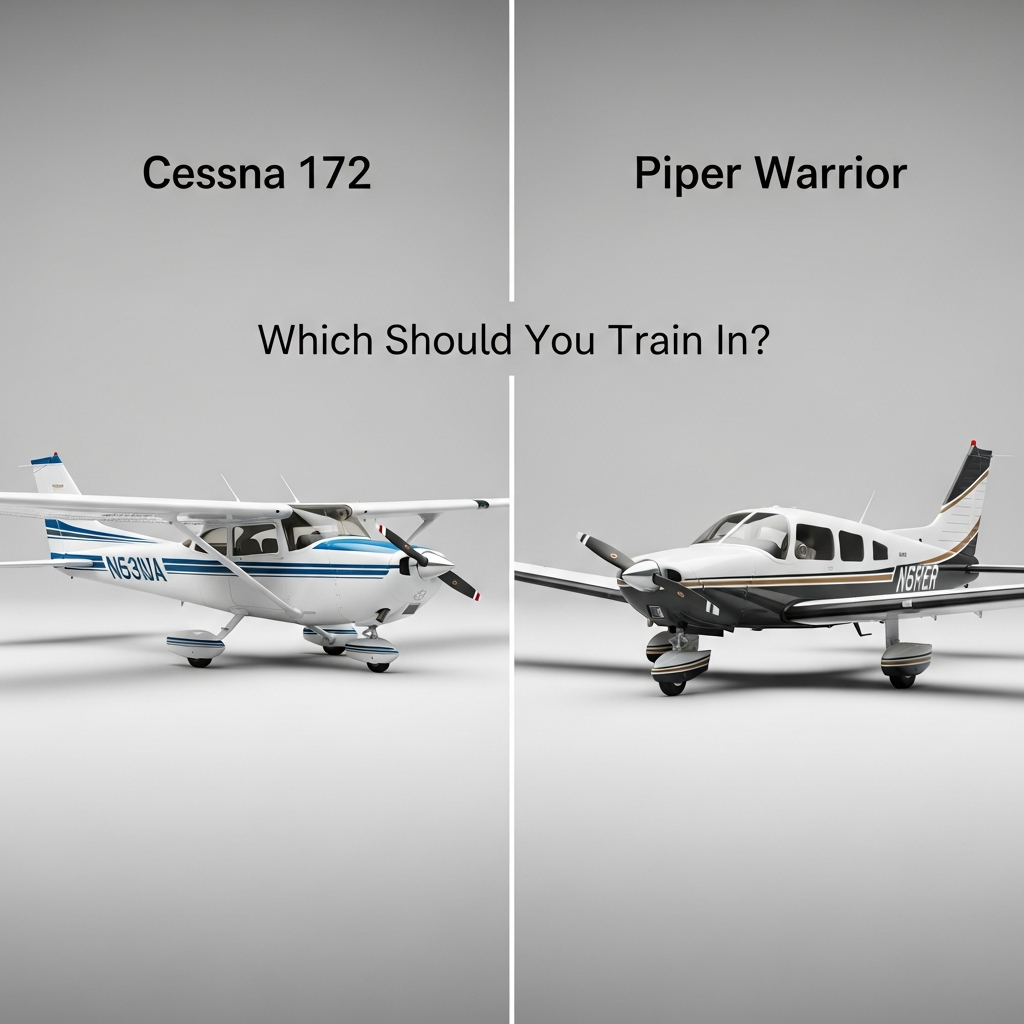
The Cessna 172 Skyhawk is a high-wing, four-seat, single-engine airplane powered by a Lycoming IO-360 producing 180 horsepower. It has been in continuous production since 1956 and is the most produced aircraft in history — over 44,000 built. The high wing provides excellent downward visibility, gravity-fed fuel, and natural shade on hot ramp days.
The Piper PA-28 Warrior is a low-wing, four-seat, single-engine airplane with a Lycoming O-320 producing 150 to 160 horsepower (depending on the model year). Production began in 1960 as the Cherokee and evolved through several variants. The low wing gives you a different sight picture, requires a fuel pump for engine start, and offers a more car-like entry experience — you step onto the wing and slide in instead of ducking under a wing strut.
Flying Characteristics That Matter for Training
Visibility: The Cessna 172’s high wing gives you unobstructed downward and lateral visibility — ideal for ground reference maneuvers, traffic pattern work, and looking for traffic below you. The trade-off is limited upward visibility, which means you need to lift the wing in turns to check for traffic above. The Warrior’s low wing blocks downward visibility in turns but gives you clear upward and forward-lateral visibility. You learn to compensate in either airplane — the Cessna pilot lifts the wing before turns, the Warrior pilot banks to check below.
Landing characteristics: The Cessna 172 has a more forgiving landing personality. The spring steel landing gear absorbs bounces, and the airplane tends to float in ground effect before settling. Student pilots find Cessna landings more predictable. The Warrior has a stiffer gear and a more definitive touchdown — you feel the landing more clearly. Some instructors argue this teaches better energy management because the airplane gives you less margin for error in the flare. Both perspectives have merit.
Crosswind handling: The Cessna 172 handles crosswinds well with its high wing and effective rudder authority. The Warrior sits lower and the low wing can feel like it wants to weathervane more aggressively in strong crosswinds. Neither is dramatically better — both require proper crosswind technique — but most students find the Cessna slightly more intuitive in gusty conditions.
Slow flight and stalls: The Cessna 172 has a more pronounced stall break — the nose drops clearly, the wings may drop slightly, and recovery is straightforward. The Warrior tends to mush rather than break sharply, which can make stall recognition less obvious for students. Both are benign training aircraft in stalls, but the Cessna’s clearer stall break arguably teaches better stall recognition for students who will later fly aircraft with more aggressive stall characteristics.
Cost and Availability
Cessna 172 rental rates typically run $140 to $180 per hour wet (fuel included) at most flight schools. Warrior rates tend to be $10 to $20 per hour lower — the 150hp engine burns less fuel than the 172’s 180hp engine, and the lower acquisition cost for schools translates to lower rental rates.
Over a 60 to 70-hour private pilot training program, that $10-20 per hour difference adds up to $600 to $1,400 in total training cost. Not negligible. If budget is a primary concern and both airplanes are available, the Warrior’s lower hourly rate is a legitimate consideration.
Parts and maintenance availability slightly favors the Cessna 172 purely due to the larger fleet — more 172s flying means more mechanics who know them, more parts on shelves, and less downtime waiting for a part to arrive. In practice, both airplanes are well-supported and neither should cause scheduling problems at an active flight school.
The Verdict: Which Should You Train In?
Choose the Cessna 172 if: you want the most widely available trainer that maximizes your options for renting at other airports after you earn your certificate. You value the high-wing visibility for ground reference maneuvers and traffic pattern work. You want slightly more forgiving landing characteristics during the early solo phase. You plan to fly Cessna aircraft after training.
Choose the Piper Warrior if: your flight school offers it at a lower hourly rate and budget matters. You want experience with low-wing handling, fuel pumps, and manual gear (in retractable variants) that prepares you for transitioning to more complex aircraft. You find the seating position and entry more comfortable — some larger pilots fit better in the Warrior’s cockpit.
The honest truth: either airplane will make you a private pilot. The difference between them matters less than the quality of your instructor, the consistency of your training schedule, and how well you study the ground material. If your school has both and the rates are similar, fly whichever one your assigned CFI recommends — they know the airplane and they know what works for students. Do not overthink the platform decision. The airplane is a tool. The skill is in the pilot.

Stay in the loop
Get the latest skyhighflighttraining updates delivered to your inbox.