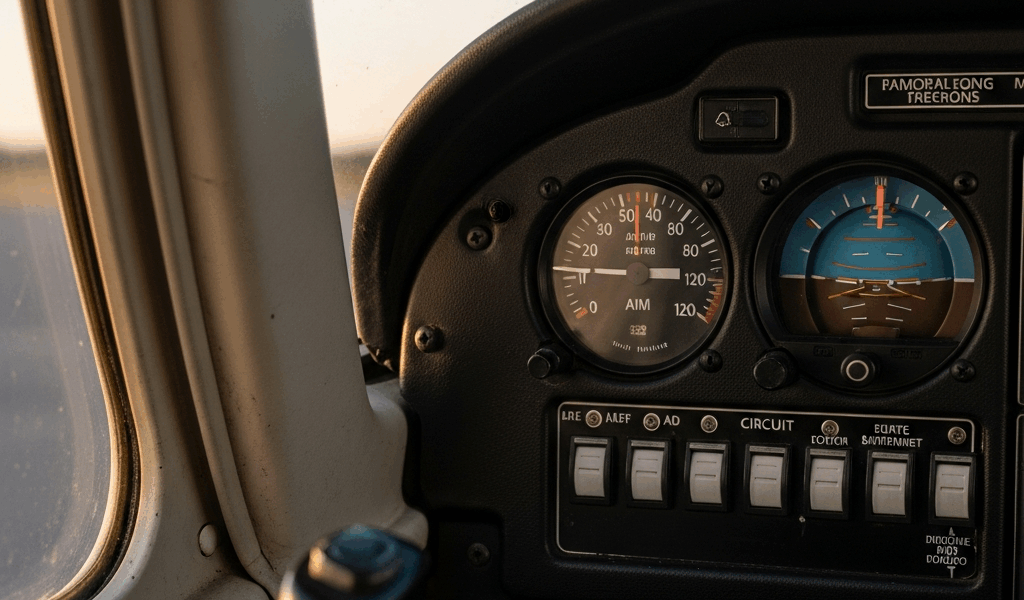
You are on a solo cross-country and the ammeter needle drops to zero. Or the landing light just went out and you are about to enter the pattern at night. The Cessna 172 electrical system is simple compared to complex aircraft, but it still trips up student pilots because they have never traced the circuit or thought about what happens when a component fails. Here is what you need to know for the cockpit and the checkride.
How the Cessna 172 Electrical System Works
The Cessna 172 uses a 28-volt DC electrical system powered by an engine-driven alternator and backed up by a 24-volt battery. The alternator produces electricity whenever the engine is running and charges the battery simultaneously. The battery provides power for engine start and serves as emergency backup if the alternator fails.
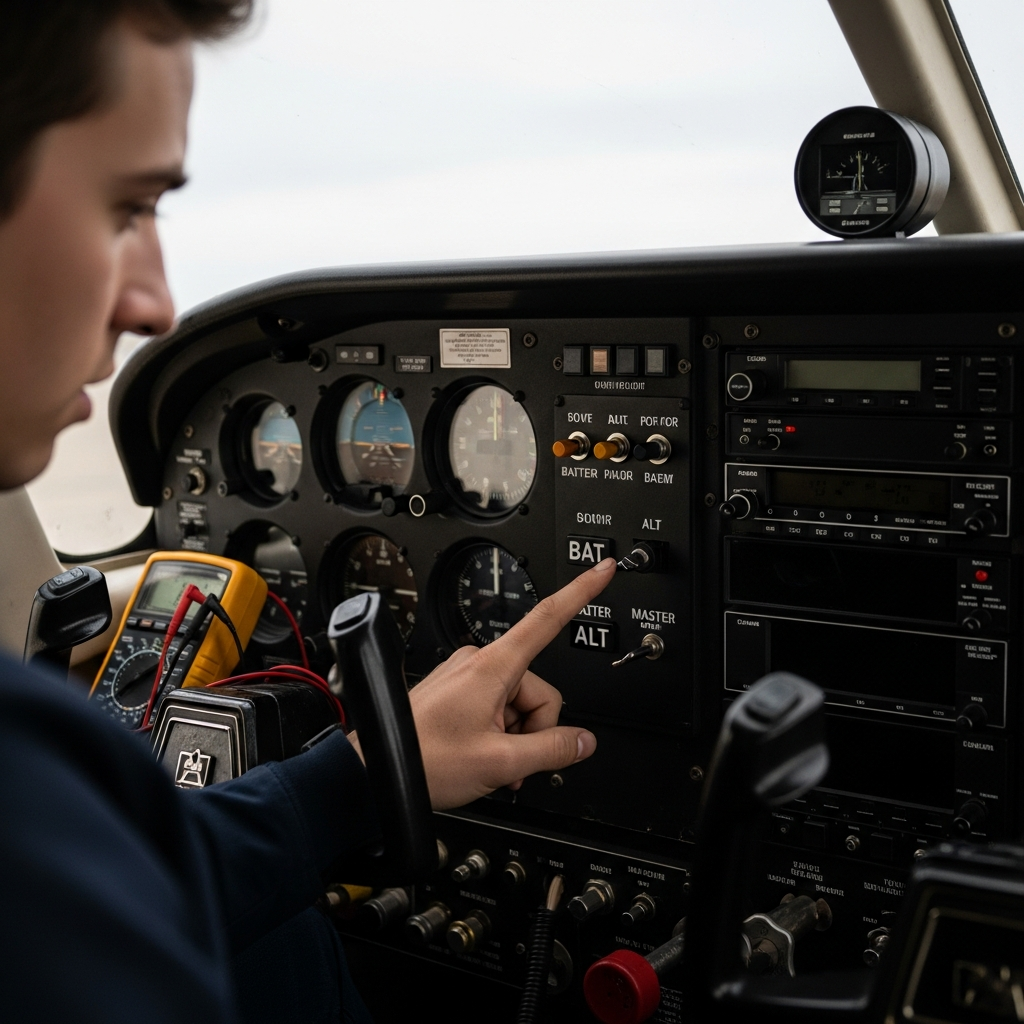
Power flows from the alternator through the main bus bar, which distributes electricity to every electrical component in the airplane through individual circuit breakers. Each circuit breaker protects a specific system — avionics, lights, pitot heat, flaps. Pull a circuit breaker and you isolate that system from the bus. The master switch has two halves: the battery side (BAT) and the alternator side (ALT). Both must be on for normal operation.
The ammeter shows the relationship between what the alternator produces and what the electrical systems consume. A positive reading means the alternator is producing more than the systems need — excess charges the battery. A zero reading means production equals consumption. A negative reading means the battery is discharging — the alternator has failed or been switched off, and you are running on stored battery power.
Alternator Failure: The Most Common Electrical Emergency
You will recognize alternator failure by the ammeter showing a discharge (negative reading) during normal flight, or by the low-voltage annunciator light illuminating. The alternator has stopped producing electricity and the airplane is running entirely on battery power.
How much time do you have? A fully charged 24-volt battery in a Cessna 172 provides roughly 30 to 60 minutes of power depending on electrical load. With everything on — radios, GPS, lights, transponder — you are closer to 30 minutes. Shedding load extends this significantly.
Immediate actions:
1. Turn off the ALT side of the master switch, wait 10 seconds, turn it back on. This resets the overvoltage relay — the most common cause of an apparent alternator failure. If the ammeter returns to a positive reading, the alternator is working again and the issue was a transient overvoltage trip. Monitor it for the rest of the flight.
2. If the reset does not work, the alternator has genuinely failed. Reduce electrical load immediately: turn off all non-essential equipment. Keep one COM radio and the transponder. Turn off the second radio, GPS (if standalone), autopilot, all lights except what you need for immediate conditions.
3. Land at the nearest suitable airport. This is not a “continue to destination” situation. You are on a countdown. Land before the battery dies and you lose radios and transponder.
Circuit Breaker Problems
A popped circuit breaker means that circuit drew more current than the breaker is rated for. This is a safety feature — the breaker tripped to prevent a wire fire behind the panel.
Can you reset it? Yes, once. Push the circuit breaker back in and see if the system operates normally. If it pops again, leave it out — the fault is still present, and repeatedly resetting a breaker risks an electrical fire. A circuit breaker that trips twice has a genuine wiring or component problem that will not fix itself in flight.
Which breakers matter most? For daytime VFR, the essential circuit breakers protect COM1, the transponder, and the flap motor. Loss of flaps means a no-flap landing — manageable but plan for a longer rollout and higher approach speed. Loss of radios means squawking 7600 (communication failure) and following lost-comm procedures. Loss of transponder means staying out of transponder-required airspace.
At night: add the landing light and navigation lights to the essential list. A night landing without a landing light is legal (you can land with position lights and a flashlight if needed) but it dramatically increases risk. If the landing light breaker pops at night, land at the nearest well-lit airport immediately.
Electrical Fire: The Scenario You Must Know Cold
Electrical fire is the most dangerous electrical emergency and the one your DPE will almost certainly ask about. A burning-wire smell in the cockpit requires immediate action.
Memory items (commit these to memory):
1. Master switch — OFF. This cuts all power and should stop the fire at its source.
2. Cabin vents — OPEN. Clear the smoke so you can see instruments and outside.
3. Cabin heat — OFF. The cabin heat duct routes through the exhaust system and can draw smoke into the cabin if left on.
4. Fire extinguisher — USE if fire is visible and accessible.
After the fire is out and smoke has cleared: if you need electrical power to navigate or communicate, turn the master switch BAT side back on and individually activate only the systems you need, one at a time, pausing between each. If the smell returns when you activate a specific system, that system is the source — turn it off and leave it off. Land as soon as practicable.
What Your DPE Will Ask
Expect these questions on your private pilot oral exam: What powers the electrical system? What is the difference between the BAT and ALT sides of the master switch? What does a negative ammeter reading mean? Walk me through an alternator failure. What do you do if a circuit breaker pops? Describe the electrical fire checklist. How long will the battery last without the alternator?
Know the system, know the emergencies, and know the memory items. The Cessna 172 electrical system is straightforward, but a student who cannot explain it or handle its failures on the oral exam will not pass. Practice until the emergency procedures are automatic — in a real electrical fire at night, you will not have time to look anything up.



Stay in the loop
Get the latest skyhighflighttraining updates delivered to your inbox.